
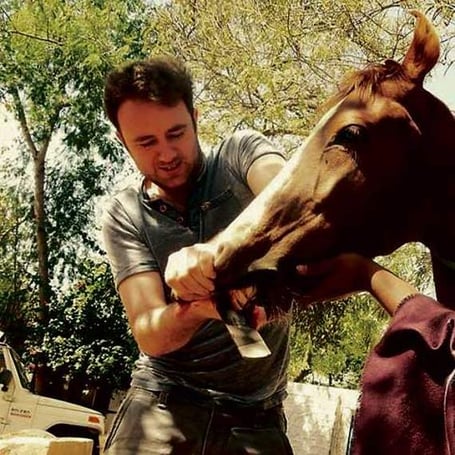
A VET who grew up on a farm near Lifton will soon be presenting the petition he started calling for a ban on prescribing homeopathy as a treatment for animals to the Royal College of Veterinary Surgeons (RCVS).
Danny Chambers, who graduated from the University of Liverpool’s School of Veterinary Science in 2008, set up the Change.org petition, which went live at the end of last year.
The petition so far has received more than 2,500 signatures — including support from more than 1,000 vets.
An open letter alongside the petition to the RCVS, reads: “The biggest danger of homeopathy is not that the remedies are ineffective, but that some homeopaths are of the opinion that their therapies can substitute for genuine medical treatment. This is at best misleading, and at worst may lead to unnecessary suffering and death.”




The British Association of Homeopathic Veterinary Surgeons (BAHVS) describes homeopathy as ‘a system of medicine that bases its therapeutics on the principle of ‘let like be cured by likes’ — ‘similia similibus curentur’’.
It continues: “The medicines used may be derived from animal, vegetable or mineral sources and, in latter times, remedies have also been derived from man-made substances.”
The BAHVS said under the Veterinary Surgeons Act 1966, it is illegal for anyone other than a RCVS-registered veterinary surgeon to prescribe homeopathy for animals or to diagnose or give advice based upon a diagnosis.
The association on its website gives details of veterinary homeopathy education — a full course providing a minimum of 120-hours tuition, spread over three years.
There is also a post-graduate examination, and those who pass are entitled to use the letters ‘LFHom(Vet)’.
Mr Chambers told the Post: “I have been writing letters and debating the issue in the Veterinary Times for about three years now. I was very frustrated that some animals can be given an ineffective alternative therapy instead of an appropriate medicine, which would actually help them.
“There are some diseases that can be managed very effectively with a proven medicine, for example Cushings disease in a horse, and if you give homeopathy instead then you are withholding treatment. This means it is an animal welfare issue and is a disservice to the owners.
“I was confident that we would get over 1,000 vets to sign the petition because it is such a clear cut issue.”
He said there has been a ‘general increase’ in the use of alternative medicines in both human and veterinary medicine, adding: “This is coupled with a significant anti-vaccination movement and an increasing distrust of doctors and vets over the last few years. Many people believe that vets are primarily concerned with making money, so they get their information online, which is often inaccurate.
“I believe that vets and doctors have to be better at communicating with people, so they can reassure them that we do have their best interests at heart. We need to be able to justify any treatment and fees by explaining how it will benefit their animals.
“If people are dissatisfied with conventional medicine they will seek out alternatives, which can be dangerous and a big waste of money.
“Sometimes owners try homeopathy if their animal is terminally ill because they don’t want to euthanise. This is understandable, but in reality it gives owners false hope, wastes their money and prolongs suffering unnecessarily.”
When asked for a comment, a spokesperson from the BAHVS said the RCVS — it’s governing body — has a position statement on the practice of homeopathy by qualified veterinary surgeons.
Part of it reads: “Whatever views there may be within the veterinary profession it is clear that there is a demand from some clients for complementary and alternative therapies. It is better that they should seek advice from a veterinary surgeon — who is qualified to make a diagnosis, and can be held to account for the treatment given — rather than turning to a practitioner who does not have veterinary training.
“Any decision by the government on NHS funding of homoeopathy does not change the position that homoeopathy is accepted by society, recognised in UK medicines legislation and does not in itself cause harm to animals. While this is the case, it is difficult to envisage any justification for banning a small number of veterinary surgeons from practising homeopathy.”
The petition and open letter, which Mr Chambers will soon deliver to the RCVS, can be viewed at www.change.org/p/the-royal-college-of-veterinary-surgeons-a-call-to-ban-veterinary-surgeons-from-prescribing-homeopathy-as-a-treatment-for-animals
Comments
This article has no comments yet. Be the first to leave a comment.