
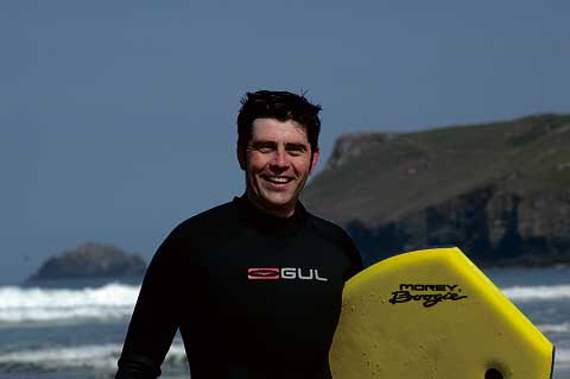
NORTH Cornwall’s MP has criticised Cornwall Council’s ‘surf tax’, describing it as ‘immoral’ and ‘regressive’.
But some in the Bude area say the surf tax — Cornwall Council’s water-based activity licensing scheme — is a complicated issue.
Cornwall Council said the aim of the scheme is to ‘ensure that all businesses operating from council beaches are properly insured and have trained and qualified staff as well as helping to generate income for the authority’.
Conservative MP Scott Mann issued a freedom of information request (FOI) to the local authority asking how much revenue the council has raised since the scheme’s inception.




The council said the scheme, which was implemented in April, will generate annual income of £31,746 from businesses that are currently licensed — over the three-year licence period this will equate to £95,238. Eighteen licenses have been issued.
The fee each business pays is determined by the maximum number of clients they intend to put into the water at any one time.
Larger businesses will therefore pay more than smaller businesses — but the council described the rate as ‘proportionate and therefore creates a level playing field for all licence holders’. The fee for each craft/client is £72.15 but this rate can vary if the business wants a licence for more than one site but does not want to operate on each site simultaneously.
Mr Mann asked the council how much it cost the local authority to implement the scheme, but the council said it had not been itemised, and ‘was absorbed within the workload of existing council officers’.
Reacting to the information he had received from Cornwall Council, Mr Mann said: “This surf tax is quite frankly immoral and regressive. Businesses which offer water-based activities, such as surfing, kayaking and canoeing, are vital for water safety and education, and this tax hinders their ability to offer these vital services.
“The tax is also very unfair because it only applies to surf schools which operate on beaches that are managed by the council.
“This tax is evidently not an effective revenue raiser and should be scrapped immediately.”
One of the two Liberal Democrat Cornwall Councillors for Bude, David Parsons, said there are two issues — ‘the first is the need to control what happens on the beaches’.
He said: “With the increased interest in surfing there are more surf schools and beaches are getting more crowded. There needs to be a licence to make sure that operators are insured and qualified and that staff are appropriately checked. I believe that the reputable operators understand that is needed. There also needs to be a limit on how many schools are on each beach.”
He said the second issue ‘is whether anyone that makes a profit operating on Cornwall Council land should pay a fee for doing so’.
Cllr Parsons added: “That is where the controversy lies. The National Trust charges the surf schools on their beaches and I believe other private beach owners charge. Leisure trainers also pay to use Bude Canal so the precedent has been set.
“I, together with others, was against the original scheme which was aiming to raise a lot more money than the current arrangement. We opposed this and reduced the charges for this year as a trial to review the effect on businesses.”
Businesses licensed include Outdoor Adventure at Widemouth. Andy McKenzie, of Outdoor Adventure, said previously there had been a ‘waves licence’ that cost around £150 to £300, but this was voluntary to join, and operators that didn’t join were still able to operate.
Mr McKenzie said under the ‘surf tax’ Outdoor Adventure is paying nearly £2,500, on top of business rates.
He added: “There was never any issue with contributing a fee, but we are not sure what that money is going towards — increasing the money the council has or making the water safer?
“If it’s keeping the beaches safe there’s no problem with that.
“At the end of the day it’s their land and we are making money from their land. But the fact we are all small businesses — small businesses in Cornwall drive tourism.
“The scheme itself, from Outdoor Adventure’s point of view, we don’t necessarily have an issue with but we are unsure what exactly we are paying for.”
MLH Surf Coaching, based in Bude, started out this year. It is run by British Champion surfer Miles Lee-Hargreaves.
He said on the ‘surf tax’: “I think it’s really wrong for small businesses that Cornwall is based on, Bude being a small town with small businesses trying to get started.
“They are doing it to promote the safety and have a policy on quality. If that was in place it would seem quite good but it doesn’t seem like anything of that is happening. It seems they are saying we need a piece of that pie.”
Liberal Democrat Cornwall Councillor for Bude Nigel Pearce said: “Last year Lib Dem Cornwall councillors asked Cornwall Council to change their minds charging the surf schools, but the council decided to proceed anyway.
“My fear is the cost of the council’s red tape will be a burden on the surf schools and will not raise any income for the council.
“I’ve had many meetings with the surf schools and they are very concerned about the council’s fees and I believe we should be doing everything we can to help Cornish businesses.”
A spokesperson for Cornwall Council said: “The licensing scheme for water based activities was introduced in April 2016, following extensive consultation with the industry who helped to shape the terms of the licence. The aim of the scheme is to ensure that all businesses operating from council beaches are properly insured and have trained and qualified staff as well as helping to generate income for the authority.
“The council has a responsibility to ensure that anyone visiting a council beach and using a surf school can be confident that they are using a company that meets all health and safety criteria and is suitably skilled and qualified to instruct the public, some of whom could be taking part in a water based activity for the first time. The council, like other landowners such as the National Trust and the Duchy, already charges other businesses operating from its beaches and, therefore, feels it is not unreasonable to expect surf schools to also pay a fee to use these assets.
“The council is facing significant financial challenges following the cuts in its funding from the Government and has been forced to look at ways of generating additional income to avoid having to reduce services. The income generated from this scheme is being used to help support the ongoing management and maintenance of the council’s beaches and coastal assets.
“Businesses taking part in the scheme have told us that having a licence to operate provides them with a level of certainty around their business.
“We are promoting the businesses taking part in the scheme on our website and are installing signs at each beach so that the public will know which companies are licenced operators.
“The scheme is set to continue, however we will be reviewing the way it is operating during the licence period and may make changes in the future, subject to feedback received.”
Comments
This article has no comments yet. Be the first to leave a comment.