

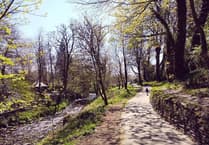
THE landscape of Bodmin Moor and the surrounding areas near Camelford have inspired a Cornish novel that has hit the shelves recently.
Michael Tanner, author of The Fogou Episode, describes himself as a ‘compulsive’ writer. He said: “I have always found this a double-edged sword. A word, a phrase, an idea comes into your head like something that’s just come through the letterbox and must immediately be picked up. Picking it up means finding your pencil, pen — whatever comes to hand — and the paper to capture it on. This is fine for anyone in a recluse’s world, but, if you have to support a family, take an exam, submit a tax return, keep to a deadline, any one of the million distractions yapping at a man’s heels, being a compulsive writer can be anything from embarrassing to exceedingly frustrating. You can see why I did not become an airline pilot or a bank manager.”
So what might all this have to do with The Fogou Episode, and where did that come from? ‘Fogou’ is an ancient Cornish word, which some of the Cornish have actually heard or seen, especially if they live on or close to Bodmin Moor or its southern outcrops. Michael continued: “Whether my paternal grandmother, a Pascoe of Cornish extraction, knew it, I will never discover. Regrettably, I met her only once in my life when I was about seven years old — a silent old lady, dressed in mourning black. What memories silence can lock away forever!
“Only recently, while browsing Google, did I see that Tony Robinson of TV fame had, many years ago, actually been the presenter of a TV programme, which, in its title, contained the word ‘Fogou’ — pronounced ‘foe-goo’. I first came across the word in virtually the same way as the boy hero ‘Harry’ in my novel. You can find the meaning in The Shorter Oxford — more or less as Harry did.”

.jpeg?width=209&height=140&crop=209:145,smart&quality=75)
However, Harry did not have the two immensely heavy volumes of that dictionary, which are carefully preserved amongst the many books bulging from the walls of Michael’s bedroom-study. The author has spent much of his life pursuing words, in one language or another.
Michael, born in 1933, was brought up in Bristol. He was a Second World War evacuee to Devon, and graduated at Bristol and London universities. He earned a living mainly as a teacher in secondary schools, going on to finish as a deputy head in Guildford, Surrey. Michael helped to bring up five children and lives in Surrey.
He describes his main hobbies as writing poems, short stories and articles, mainly about the environment. He also enjoys restoring old stone cottages during the holidays, running and walking, learning languages — particularly French and Russian — and trying to play the clarinet.
Michael was a teacher of English for most of his working life, balancing this with his passion for writing. He said: “But it was all kinds of words in all kinds of contexts — early on I became fascinated with linguistics, the whole essential matter of language. I’m still almost back where I started, despite all the help, which Professor David Crystal and many experts long since dead — including the brothers Grimm — have afforded. Well, life if just not long enough, is it? I do empathise with those exquisite little damselflies, which every summer dance across the surface of my garden pond.”
Michael’s busy and active lifestyle helped to introduce him to the setting behind his novel. Having joined the Somerset Light Infantry for his National Service, he began running marathons in his late 40s, completing the first ten London Marathons and quite a number elsewhere by the time he was 60. Incidentally, Bodmin Moor became one of his training grounds. Michael ran across the moor in all weathers — sun, rain, mist and even once a blizzard. Inevitably, Bodmin Moor became the setting for his novel. He added: “It was good enough for du Maurier’s Jamaica Inn.”
He explained that childhood in wartime, the moors of North Cornwall, the consolation of natural beauty and nature’s processes and war itself are the ‘main intertwining strands’ of The Fogou Episode. The novel is also pervaded by a sense of something beyond convenient definition — something in landscape and rock and the natural elements, which takes man into account and preserves its own record, subsuming ancient churches such as Advent on the moor, subsuming the hut circles, the towering tor, the seas to west and south east. The novel follows evacuees Valerie and Harry in 1943 who have come from war-torn London and Plymouth to settle in the Cornish countryside.
Michael continued: “I am not Cornish, but have it in my genes. I discovered Cornwall’s northern edge on foot, walking from North Devon in Army boots one sunny day after a short spell at the Combined Ops HQ in Fremington, North Devon, where we — the University Training Corps cadets — had the dubious excitement of an exercise in coming ashore from landing craft, with the professionals putting 25lb shells and smoke over our amateur heads.
“On a sunny afternoon at the finish of that, by lifts and boots I got just about as far as Bude. I had actually set foot in Cornwall — must have been about 1954.
“I didn’t get back until about 12 years later, when I first saw Roughtor and just had to climb it. By then I was older, but not much wiser. Already I was supporting a young family, had borrowed a small sum of money and bought a dilapidated little stone cottage in a minute hamlet about five miles from the summit of Roughtor. Funny how all that has not faded so very much into the fabled mists of time, which, I think, can hardly be more obscuring than the mist which one day lay between Jamaica Inn and the little town I was aiming for across the moor, on foot.”
He added: “Even in my serious moments, I still think the story at the centre gets near an uncomfortable truth, tucked securely away in somebody’s archives — the moor, those heavy bomber runways sticking through the turf, the Fogou itself — all whisper that is so.”
With help from locals, the novel’s front cover was illustrated by Camelford’s John Blight from the Camelford Gallery, and Michael has extended thanks to David Keast, founder and curator of the RAF Memorial Museum at Davidstow for his assistance with the history of the ‘secret’ aerodrome.
The Fogou Episode is available for sale from Amazon Books, for downloading from Amazon onto Kindle, and for reading about via thefogouepisode.com. The book will also be available in a number of bookshops including Wadebridge and from the Camelford Gallery, owned by artist John Blight.
Comments
This article has no comments yet. Be the first to leave a comment.