

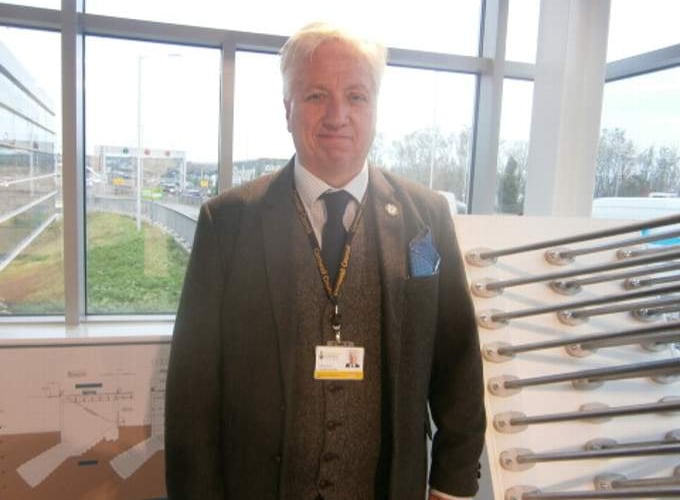
MARTIN Worth is Conservative Councillor for Saltash, Trematon and Landrake Ward and Joint Chair of Tamar Crossings with Plymouth Councillor Jonathan Drean.
Cllr Worth joined Cornwall Council in May after the local elections, and after becoming a county councillor he was asked what he would be interested in doing – his background is in design technology and commerce – and whether he’d like to be involved in the bridge and ferry.
He jumped at the chance as he was very aware of the bridge’s importance from having been brought up in South East Cornwall – and in fact he was wheeled across the bridge in a pram on its opening day in 1961.
Although he was actually born in Reading in Berkshire – because his father, who was an engineer with the railways who had worked on maintaining the Royal Albert Bridge, had been given a promotion in that area at the time of his birth – at the age of three- and-a-half he was brought to Saltash to live after his parents moved back to Cornwall. He subsequently went to Saltash School and was a musician in the Cornwall Youth Orchestra.

He was a classical bass player but at the age of 13, when he was taking part in a production of Joseph and His Amazing Technicolor Dreamcoat, his mother bought him a bass guitar and he still plays bass guitar today and at one time ran a music shop in Plymouth.
Later he moved to Chislehurst in South East London, but he always came back to Cornwall for “high days and holidays” and family events, so he was always aware of the importance to people’s lives of the Tamar Bridge. Now he is back in the area, he lives at Cargreen.
He says his mother Joan was always very much involved in life in Saltash and when he himself became chairman at Landulph Parish Council, it effectively began his political career. When South East Cornwall MP Sheryll Murray suggested to him that he stand as a Cornwall Councillor, he decided to do so in honour of the service that his mother had given to the Saltash community.
He has found representing his ward a real pleasure because of the warmth of the local people – he had recently been at Ashtorre in the town and people had been coming up to him remembering his mum.
As regards his involvement in the Tamar Bridge, he said at this point in its 60th year he was conscious that they had to consider how to take its operation forward because it is so important to many people in the area – in fact it is a crucial crossing.
Many take it for granted as part of life and it is only when traffic flow gets disrupted by events such as the recent resurfacing, with the resulting problems and delays to their journeys, that people start to think about how important the bridge is to them.
There is also the question of the impact of the COVID crisis – has that had a permanent effect on patterns of traffic movement and revenue? It’s hard to tell as there is no ‘new normal’ quite yet, but there are bound to be ways that life will be different from now on.
On Cornwall Council, Martin is deputy to Cllr Phillip Desmonde, portfolio-holder for Transport, and so is part of the council’s plan to put pedestrians and cyclists further up the ‘pecking order’ of road users while putting drivers of four-wheel vehicles further down the list. As for promoting public transport, he himself drives a community hopper bus. When asked if in the future the bridge should be subsidised, he said that in the 1950s when the bridge was being planned, the philosophy was very much that “the user pays – and that was absolutely right for that period”. But what is the new normal now if we look around the country?
Some bridges like the Severn Bridge and Severn Crossing no longer have tolls, and in East London you don’t have to pay to use the Woolwich Ferry across the Thames.
Somebody has to pay to maintain the Tamar crossings, but should it just be the people of Cornwall and Plymouth, or the people of the UK as a whole?
He said we don’t stop the trains crossing the Royal Albert Bridge and ask people to pay tolls, so what’s the difference that means we charge motorists? Both road and rail crossings are national infrastructure and have to be maintained to provide the service we expect, and that maintenance has to be paid for somehow.
Comments
This article has no comments yet. Be the first to leave a comment.