
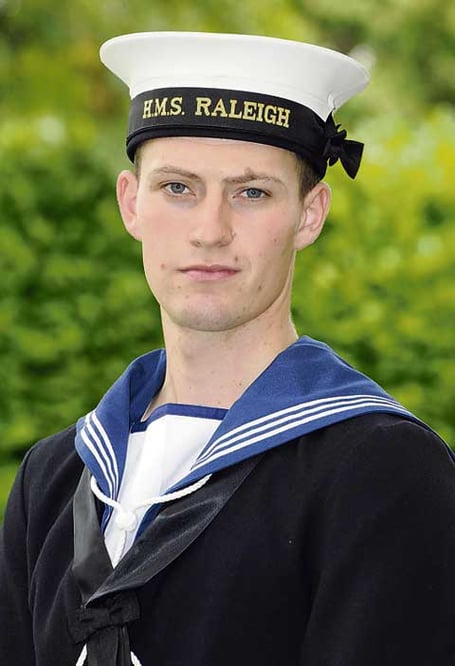
A 22-YEAR-OLD Royal Navy recruit from West Landue, Lezant, is now one step closer to a career at sea after becoming one of the first to undergo a newly enhanced basic training course at HMS Raleigh in Cornwall.
Trainee Seaman Specialist Sam Scott embarked on his Royal Navy career in May and has now completed 10 weeks of intensive training designed to transform him from a civilian into a sailor. The course culminates in the passing-out-parade attended by families and friends.
The former pupil of Launceston College also studied at Duchy College and previously worked as a butcher and a general labourer.
Sam said: "It's been my lifetime ambition to join the Royal Navy. I wanted to maintain a safe career, to travel the world, learn new skills and serve Queen and country. Physical training has been my strongest attribute during the course.




"The training on the sinking ship simulator, Havoc, was a big highlight, as it was realistic, exciting and gave a big insight into what it would be like on a damage ship. Overall training has been a tough challenge, but it has made me much more confident in all aspects and I'm looking forward to progressing further into my Naval career. Completing the 10 week course is a huge achievement and it means I leave Raleigh with my head held high."
With the first phase of his training complete Sam's next challenge is to learn how to manoeuvre the ship, crew the upper deck and operate the smaller, faster boats of the Royal Navy's Surface Fleet.
This stage of his training will take 10 months and will be split between HMS Collingwood in Hampshire and HMS Raleigh.
The Royal Navy's Initial Naval Training course is underpinned by nine Core Maritime Skills, that are the foundations of naval life and underpin operational effectiveness. Recruits are taught the basics of Naval discipline and customs. They learn about navigation and are given the chance to take the helm of their own medium sized inflatable boat during a waterborne orienteering exercise.
With Royal Navy personnel playing a vital role in Afghanistan and other land-based operations, recruits undergo training in basic combat skills which includes survival in the field.
Fitness is a key component of the training and is delivered using a disciplined method of military fitness which focuses on developing co-ordination and individual physical strength and endurance.
As the course progresses the recruits take part in three extended exercises to test their skills and understanding of the principles they have been taught.
Comments
This article has no comments yet. Be the first to leave a comment.