

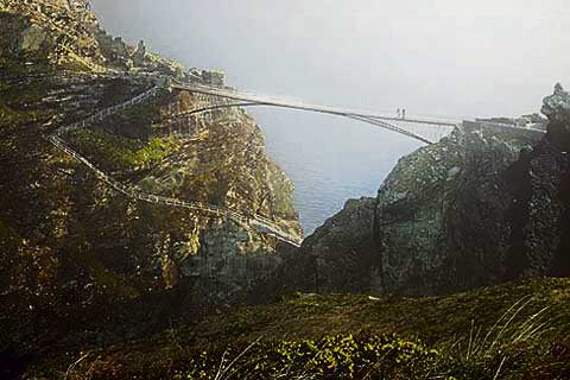
IN a comprehensive letter of objection to the proposed footbridge at Tintagel Castle, currently under the stewardship of English Heritage, Cornish historian, archaeologist and author Craig Weatherhill, a retired planning officer, has joined many others including ‘Kernow Matters To Us’ (KMTU) in condemning the proposal, writes David Sillifant.
There has been widespread opposition to the multi-million pound project of a much loved and ancient site situated on Cornwall’s rugged north coast.
Mr Weatherhill’s letter, which has been sent to Cornwall Council and is on their planning site, is damning of the proposals, saying: “Tintagel is a highly sensitive archaeological site and of iconic importance to the people of Cornwall, not so much by its very tenuous links with the Arthurian legend, but through its very real links with the Kings of Dumnonia, the post-Roman southwestern Celtic kingdom of which Cornwall was part, and who are given very little mention by the site’s current and externally based managers.
“This world-famous site falls under several landscape and heritage designations, not least of which are: Scheduled Ancient Monument, Area of Outstanding Natural Beauty and Site of Special Scientific Importance, the last with regard to the geology of the site. These designations must be of paramount consideration in the processing of this application.

.JPG?width=209&height=140&crop=209:145,smart&quality=75)

Mr Weatherhill’s points, that were included in his letter of objection, included: Impact on the scheduled ancient monument; The entire essence and experience of Tintagel Castle and headland is one of wild, natural grandeur and deeply significant antiquity;The footbridge bridge would be 66 metres long and 60 metres above sea level meaning it would ‘visually dominate’ the site.
He also said the footbridge would ‘detrimentally distract attention’ from the real value of the historic location.
Other points of concern were stability and safety: Ability of the slate geology to withstand the bridge; The way the footbridge slopes causing vertical movement to the structure; The height of the bridge if a person falls; The dangers of the 100mm symbolised gaps and the injuries it could cause; Wind speeds ‘will cause the bridge to be closed a lot anyway’. Cost and justification (including access): The applicant has yet to publically announce the cost of the project; The applicant ‘has not demonstrated adequate need or justification for the development, other than ‘ease of access’’; The applicant claims that the application follows ‘extensive stakeholder and public consultation’ ‘but that must be contested’; The applicant alleges that ‘a majority are in favour’ of the proposal despite ‘no public survey being carried out’; How would the Outer Ward being accessed by the disabled or less able?
In response, English Heritage’s head of operations in Cornwall, Georgia Butters, said: “Our proposed footbridge follows the same path as the historic approach to the castle and will allow people to better understand the history of this remarkable site. In fact, it was this narrow approach to the fortress that probably gave Tintagel Castle its name in the first place. The bridge will also provide easier access to the promontory so that more people can experience and enjoy the castle.
“We welcome all feedback as it is important that we get this right. Over the past year, we’ve been consulting with — and listening to — the public and interested parties. We’ve also been busy conducting tests to ensure that the footbridge can be built and that it can resist the strong winds.
“The footbridge is part of a wider programme of landscape improvements to protect the archaeology and ecology across the entire site. Above all, the footbridge is designed to complement, not compete with, the surrounding spectacular landscape.”
The planning application and the public comments on the proposal can be viewed via www.cornwall.gov.uk/environment-and-planning/planning/online-planning-register/
Comments
This article has no comments yet. Be the first to leave a comment.