
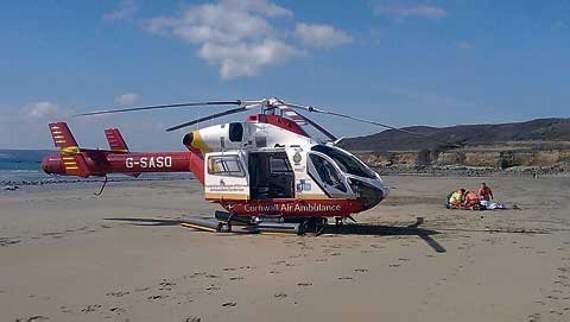
LAUNCESTON was one of the busiest areas for airborne missions in North and South East Cornwall by the air ambulance last year.
More than one in five patients attended by Cornwall Air Ambulance last year were in the northern and south eastern regions of the county. This is 151 patients from a total of 710 that were attended throughout Cornwall by the medical emergency helicopter service.
The three areas in the northern and south eastern region that saw the most airborne missions were Launceston, Bodmin and Wadebridge.
During 2015 one in four emergencies were cardiac-related. The medical helicopter service attended 410 patients with illness and 276 with injury.

Ninety-one patients had fallen, 81 had been involved in road traffic collisions and the paramedic crew aided 76 babies and children.
The air ambulance landed in Launceston and its surrounding area 12 times for patients suffering severe medical illness and four for people who had sustained injury through accidents.
One of these was an 11-month-old baby with a lung complaint who the paramedic crew airlifted to Derriford Hospital.
Another child from the Launceston area sustained severe injuries following an accident at a car rally.
The air ambulance attended 15 emergencies in the Bude area last year. Nine patients were airlifted to Derriford Hospital and three were taken to North Devon District Hospital. Four had suffered injury through falling and one of the patients sustained a significant eye injury while playing golf.
The paramedic crew flew to the aid of seven patients in Tintagel. Three had suffered falls — one fell from scaffolding and sustained head injuries and was flown to Derriford Hospital, and two others were taken to the Royal Cornwall Hospital at Treliske.
Padstow saw the air ambulance fly to attend seven patients, six of whom were flown to Royal Cornwall Hospital at Treliske.
Three patients were airlifted from Rock to the Royal Cornwall Hospital and, in October, one of these was two-year-old Rosanna.
Her father, Tom, said: “I found my two-year-old daughter unconscious, having fallen from a top bunk bed. It was by a long way the most frightening thing I have experienced in my life. Thankfully, she was still alive and after a minute or two I brought her round and established that she wasn’t paralysed either.
“Nonetheless, there seemed to be something very wrong and so I called the ambulance service. What happened next came as a surprise — because the nearest ambulance was too far away and, I guess, the risk level was considered high enough, I was informed that the air ambulance was being sent.
“The helicopter arrived incredibly quickly, no more than ten minutes after the operator told me this decision had been made. They landed on the beach and two paramedics jogged up to the house, asking me a few questions along the way.
“We want you to know how grateful we are to all the people involved in this event for taking such exceptional care of our daughter. At all times each member of your team was calm, gentle and clear with what they were doing. The high level of training and their skills and talent were self-evident — they were all extremely impressive. Their professionalism and attitude were second to none and each and every person did a fantastic job.”
Rosanna’s mother accompanied her in the air ambulance and it took just ten minutes to reach the Royal Cornwall Hospital. Happily, Rosanna made a full recovery.
Cornwall Air Ambulance also flew to the aid of 16 patients in the Wadebridge area. Twelve were flown to the Royal Cornwall Hospital and two to Derriford Hospital. Two of these patients were toddlers with respiratory problems and one was a man who fell while doing some DIY at home.
The air ambulance attended 16 medical incidents in the Bodmin area last year, including four cardiac emergencies and two equestrian accidents.
Four children under the age of four were treated by the paramedic crew. A toddler with respiratory problems was airlifted to the Royal Cornwall Hospital and a very young infant with severe burns was flown to the Bristol Royal Infirmary.
The paramedic aircrew treated 13 patients in and around Liskeard. Ten of these were cardiac emergencies, one was a rider thrown from the horse and one was trampled by cows. Five patients were airlifted to Derriford Hospital, including a young infant suffering a seizure.
The air ambulance crew aided 13 patients in the Newquay area last year, including seven medical emergencies and six trauma cases. Four of the trauma patients had fallen, including a child who had fallen in the local skate park.
Nine patients were airlifted from the St Austell area, including a cyclist and motorcyclist, following two different road traffic collisions.
Paula Martin, the chief executive officer of Cornwall Air Ambulance, said: “It takes Cornwall Air Ambulance an average of just 12 minutes to reach a patient in Cornwall. Many areas of the north coast and around Bodmin Moor are remote from hospitals, and often difficult to access by land ambulance, making the air ambulance essential.
“It is thanks to our generous and loyal supporters that we can help people in their hour of need. We fly them to the hospital that best suits their needs as fast and efficiently as we can, providing first class critical care to them every second of the journey. Thank you to all those who enable us to provide this lifesaving service.”
Last spring Cornwall Air Ambulance launched two new rapid response vehicles (RRVs) to enable the paramedic crew to attend emergencies even when bad weather prevents the helicopters from flying. Since April the RRVs attended 94 patients around the county.
Cornwall Air Ambulance costs £3-million per year to operate. With no direct government funding, the charity relies on the generosity of the people and businesses of Cornwall.
For further information visit cornwallairambulancetrust.org