
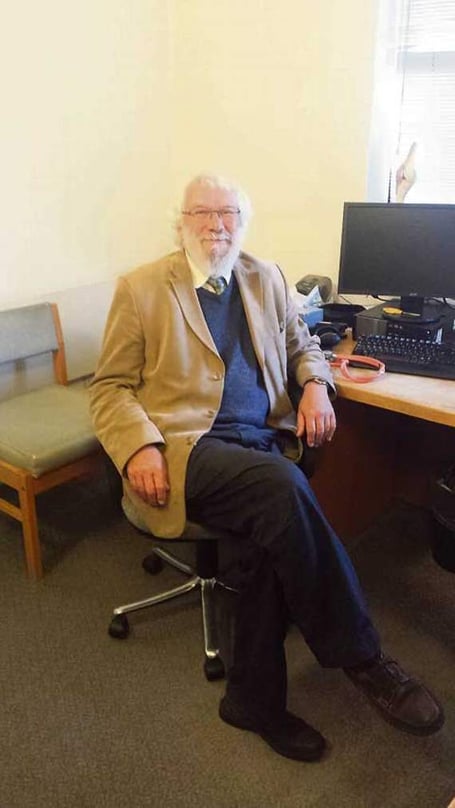
AFTER 40 years in the profession, Dr Robert Morice is leaving the world of general practice to settle down and enjoy his retirement. He will be missed at Launceston’s Medical Centre as he was among the first to start there when it was moved from its original site in the town in 1992.
His parents were originally from Ipswich, his father having been a career army officer since the mid-1930s. The family followed him round the world to his various postings. His earliest memories are of being a small child in Egypt then, after a short spell back in the UK, he spent three years of his late primary school age in Germany on a British army base on the Rhine: “Contact with the locals was limited and unfortunately no attempt was made to teach us German in school. After three years we returned to England where I attended a grammar school in Woking, Surrey.”
After always having an interest in medicine and the sciences, Dr Morice decided to begin his medical career at University College London where his pre-clinical studies focused on anatomy, physiology, biochemistry and psychology.
One event that stood out for him during this time was a short series of lectures given on the history of medicine: “As soon as the lecturer walked into the room I recognised him as Dr Jonathan Miller from ‘Beyond the Fringe’. I remember he gave an erudite lecture on 19th century neurological anatomy seamlessly switching between English, French, German and Italian. I have always envied him his subsequent career as an opera producer.”



After those two years of study and the rigorous Pre-Clinical examinations, he then had to complete three more years of clinical training at University College Hospital before he was able to begin his career doing various surgical and medical jobs in London. These included posts in General Medicine, Surgery, A+E, Obstetrics and Paediatrics before finally making the decision to come to Cornwall.
He and his wife moved down to Launceston from London in 1979 leaving behind the smoke of the big city for the fresh country air. He then joined the Launceston team as a GP registrar, referred to then as a trainee, alongside Reginald Hussey, Rob de Glanville, Paddy Collier and John Wheal.
“I am the last practising member of that original group and back when I started we had around 11,000 patients to tend to. I think its now been estimated in the most recent count that there are somewhere in the region of 18,000 patients, it just shows how much we have expanded in forty years.”
Over his years in the health profession he has witnessed many changes to protocol, practice and diseases encountered by GPs.
“The standard request from parents used to be, ‘Is it measles, German measles, mumps or whooping cough?’ and queries on many other diseases we just don’t see anymore. It also seemed that just about everybody was taking sleeping tablets”.
The role of the GP has certainly changed over the years as Dr Morice was called out many times to assess acute cardiac conditions and assist at serious car accidents and fatalities.
“Back in those days many people would want to call out the doctor before sending for an ambulance; this drastically increased wait times, which have now been brought down by the excellent work of paramedics”.
But he did voice concerns over the future of general practice: “When I first started on the road to becoming a general practitioner it was a very competitive job. Surgeries would get over 100 applicants for a single vacancy — we are lucky if we receive one or two applicants now and more often than not those are from GPs in mid-career who are simply looking to relocate.”
Dr Morice suggested that the long-term future for GPs may be in jeopardy as people are uncertain of the long term political commitment to general practice and fear they will become salaried employees of private health care companies, consequently they see a hospital career as more useful and stable.
“My take was that you were seen to be going into your own business as a GP as you would get to run things your way, but now there are so many regulations it may be putting people off.
“It seems being a GP has gone from being one of the most popular jobs to being one of the least in the course of just a few decades.”
And what will he do now he has retired?
“I am looking forward to spending more time on a few of my hobbies but will miss the practice and the wonderful team of people I have worked with for many years.”
He is a keen oboist and his hope is to be able to have more time to play with the amateur orchestral group, The Launceston Orchestra, which he currently joins once a week — it will also allow him more time to arrange music for the Baroque chamber music group he plays with each week.
“I am also a model railway enthusiast so am looking forward to dedicating more time to that in between my duties fighting back vegetation in the garden and battling the weeds!”