
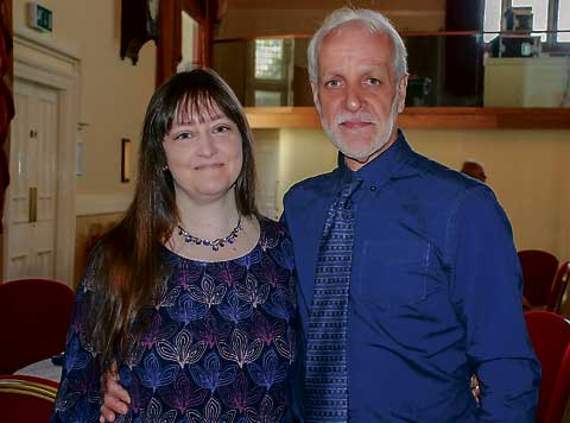
PETER Vernon, vice chairman of Launceston and District U3A, welcomed a large audience of local members and visitors from other U3As in Cornwall and Devon to the organisation’s 14th annual ‘Speakers Day’, held at Launceston Town Hall on April 11.
The first talk, entitled ‘Art in the Service of Science’, was from husband and wife team, Philip and Debbie Wilson. Both are professional medical and scientific artists, working from their studio in Treneglos.
Philip talked about the history of medical illustration from the time of ancient civilisations through to the modern use of computer-based design tools.
Debbie talked about her work in scientific and veterinary illustration. It included not only anatomical drawings, but such other things as kennel designs. Philip also showed examples of forensic medical artwork he had produced, which had to be factually accurate and acceptable to a lay jury.



Both Philip and Debbie showed examples of work they had done for a variety of textbooks, leaflets and information booklets.
The second speaker was Janet Diamond, who conveyed her enthusiasm for all things Egyptian, with her talk entitled ‘Ancient Egypt: A History in Ten Objects’. While living in Egypt for three years Janet developed a fascination with the 3,000-year history of the ancient Egyptian civilisation, which ended when it fell to the Romans in the last century BC. At this stage artefacts became buried, understanding of hieroglyphics was lost and little trace was left of the previous centuries.
With the arrival of invading armies in the early years of the 19th century a study of the old civilisation began. In the western world there was an awakening of interest in all things Egyptian, as a result of which many artefacts were ransacked and found their way to European museums, including the British Museum.
Among the objects chosen by Janet for her presentation were the mummified body known as ‘Ginger’(now housed in the British Museum), the world’s oldest boat found near the Great Pyramid, the bust of Queen Nefertiti and the Rosetta Stone.
The afternoon speaker was Dr Mike Haywood, a marine artist, who illustrated his talk entitled ‘The Voyage of the Mayflower 1620: The Myth and the Reality’ with his own paintings. He set out to debunk the myths that the Mayflower settlers were the first English settlers in North America, and that they named Plymouth, Mass, after their final port of departure from their homeland.
Mike put events in to historical perspective, explaining how the fluctuation in the affiliation of English monarchs from Henry VIII to William III between Church of England and Roman Catholic led to the religious persecution that inspired many people to emigrate.
The emigrants who left Plymouth aboard the ‘Mayflower’ on September 6, 1620 lived on the gun deck, which was estimated to be about 80’ x 24’ and 5’6” high, with very little air and light. One of the passengers, William Bradford, related how one John Howland had been saved from the sea. He went on to father ten children and 88 grandchildren. Among his descendants are three US Presidents — George Bush, George W Bush and Franklin Delano Roosevelt. Winston Churchill descended through his American mother from John’s brother Arthur.
After a gruelling voyage and spending six weeks at anchor in the lee of Cape Cod, the emigrants finally disembarked on December 25.
Many died in the first year of the settlement, including members of the crew. By the first Thanksgiving in 1621 only four women remained to care for 50 men and children. It is estimated that there are over 30-million living descendants of the 52 Mayflower passengers who had children.
Comments
This article has no comments yet. Be the first to leave a comment.