
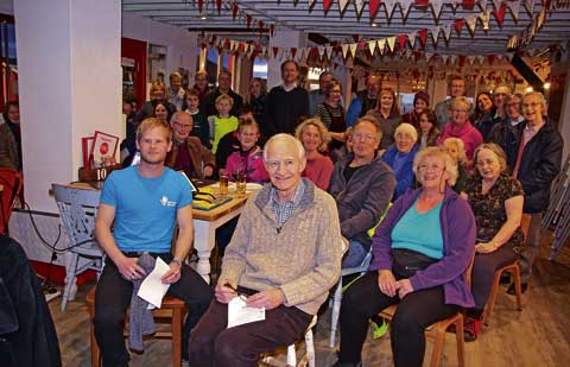
‘MY HERO’ were the words used to describe local humanitarian, Richie Heard, to a crowd of over 60 at the Bude Refugee Support Group’s recent event at Rosie’s Kitchen.
On the evening of Wednesday, March 22, crowds gathered at the popular Rosie’s Kitchen at Crooklets to attend Bude Refugee Support Group’s most recent event since finding out they had received approval from the Home Office to welcome a refugee family to Bude.
Richie, an RNLI lifeguard based at Widemouth, was introduced to the group and locals who came along to the event by the group’s chair, Mary Whibley, who described him as ‘my hero’ as he took to the front of the room.
The night consisted of some recent harrowing footage and some sombre tales from Richie’s time spent at Lesvos, Greece, helping mainly Syrian families cross the waters to seek safety in Europe.
.png?width=209&height=140&crop=209:145,smart&quality=75)

During the evening, the audience heard of Richie’s four months of work spent on Greek shores, where he experienced the true horrors and results of a conflict that has forced innocent people out of their homes, fearing for their lives and seeking safety elsewhere.
Richie went on to portray the problems involving Turkish smuggling, and how that has, ultimately, created an out-of-control crisis.
Founded by June Bennett and Joby Fox as a response to the refugee crisis in Lesvos, Richie got involved in the Refugee Rescue charity in January 2016, through a friend of a friend.
The charity needed a rescue boat, and gathered funds of £30,000 to pay for an ex-RNLI lifeboat, which could hold three to four crew. Richie was one of the first crew on the boat, and put his skills from his experience as an RNLI lifeguard to the test.
Richie has worked with other non-government organisations (NGOs) during his time in Greece, including Proactiva, which was one of the first rescue boats to arrive in Lesvos at the start of the crisis.
This jet-ski boat can carry five or six crew, and is now working on a bigger scale on the coast of Libya, picking up between 100 and 200 refugees in their dinghies.
Another organisation that Richie and his team have come across is Frontex, which was heavily criticised during the early days.
HMC Protector is a British organisation, which Richie described as ‘highly professional’.
During the early days of the crisis, Lesvos saw 4,000 refugees arriving a week to its shores. These people are often sent from Turkey, provided with poor quality boats and lifejackets, as part of the country’s smuggling purposes. Facing cold, harsh weather conditions in a traumatic and frightening atmosphere, many are left feeling uncertain about their families’ futures.
Lesbos is currently patrolled by Greek coastguards — a military force whose focus is to defend their borders. Refugees met by these coastguards can often be treated in a rough manner, receiving a frosty welcome into Europe.
Although the number of refugees arriving here has dropped to 400 a week, Richie explained that this does not mean there is less need for help.
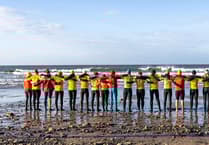
Richie’s rescue team undertook patrols of the area, which were usually split into two halves, ranging from two to six hours a night — normally from around 10pm until sunrise.
The boat carried a phone, where the crews were alerted of an incident which they could respond to. When a group of refugees is found, the people — often very shaken up or traumatised — are taken to Skala harbour, a small Greek village, where the authorities are called and are able to take down details of the refugees, whilst other NGOs are made aware.
An NGO that Richie has worked with is Lighthouse, a team of 20 to 40 volunteers who often welcome the refugees, undertake a triage on medical cases, and provide the refugees with warm clothes, food, drink and care.
This whole process can take from an hour to three hours. Richie explained that one aspect that can slow this down is the UK border police, who often check the boats to make sure everything is done properly.
Some dinghies that Richie and his team have come across are crammed with 45 to 60 people, with many sitting or lying down on the floor.
He said: “On a good day, the journey can take up to two hours. They travel at two to three knots on a good day, which is very, very slow.”
At one point, the meeting was shown a harrowing video of a casualty transfer, where Richie, Pete Green — from Crackington — and another member of crew from North Devon, came across Greek coastguards screaming at a boat of 54 refugees, and soon asked the team for assistance.
Richie and his team loaded some of the refugees onto their boat and followed the coastguards to Skala, where they tried to help the people and provide care.
The refugees spend a few nights in camps at Skala, which are often overseen by NGO volunteers. They are then taken to the Moria refugee camp, which is the main camp in Lesvos. This is an old prison, which formerly held between 800 and 1,000 inmates. There are currently 5,000 refugees crammed into this space.
Richie told the meeting: “One side of this is that the refugees are in a confined space, and they are safe. However, another side of the argument is that they are locked in behind gates, there is little immunity, space to sleep and food and water. Refugees normally spend about a couple of months here, before they are moved on to Greece and can apply for asylum.”
The meeting heard that Syrian refugees are usually granted asylum, but other nationalities — such as Iraqis and Afghans — have to fight for asylum. With many travelling without ID, the authorities normally have to ‘go on what the refugees say’. Richie said that 99% of the refugees he comes across are ‘genuine refugees with a genuine cause’.
However, this does not always deter the alleged hostility of the authorities, of which can seem very harsh to arriving refugees.
Richie said: “I will speak bluntly — the authorities do a good job, but they are very rough. They are often very hostile to the people coming in.”
Despite some horror stories, Richie said the Greeks in Skala have always welcomed the refugees with open arms. For a tiny village that Richie compared as being ‘not as far as here to Sainsbury’s’, the residents of the village were recently nominated for a Nobel Peace Prize for their acceptance and help in this crisis.
In the early days of the crisis, with 4,000 refugees arriving a week, there was a lot of wreckage. With miles and miles of Greek coastline, everything — from lifejackets and debris to dinghies and old clothes — is left there.
Richie showed the audience an image of a place known as ‘the lifejacket graveyard’, with a 15-tonne digger in the background. These lifejackets, described by Richie as ‘fake and useless’, are produced by huge companies to a low standard, and are used for smuggling the refugees to Europe in low quality boats, which Richie explained are so poorly made that a hole could be kicked in through the bottom.
Smugglers normally charge the refugees $2,000, and tell the refugees how to drive the boat themselves, sending them off with not enough fuel to last the whole journey, leaving many people stranded out at sea, often in bad weather conditions. He said: “Many of the boats you can kick a hole through; they could capsize or sink at any time.”
The meeting heard that a ‘smuggler-drop’ boat is often used, where smugglers take the refugees to areas with no patrols by the authorities or rescue crews, and leave them where they will not be found. Sometimes, refugees are forced into the water before the smuggler-drop boat reaches land, and are told to ‘make the last bit of the journey on their own’.
Answering a member of the public’s question, Richie explained that it can be very dangerous getting too close to the Turkish borders. Those who get too close are at risk of being taken to prison in Turkey.
“The most difficult thing is the sound of screaming and crying babies, and the tone in their mothers’ voices asking for you to help them. Coming back home makes me realise how lucky we are.”
When asked by a member of the public if the refugees know the dangers of the journey to Europe, Richie said: “Most people don’t realise at the time what they’re about to undertake. Most of these people haven’t even seen the sea, let alone know how dangerous it is.
“As a European country, we can’t dictate what goes on in Turkey, and that’s where the politics come into place. There’s not a lot we can do other than put pressure on Turkey to quell smuggling. These countries need more support from the EU, and that doesn’t mean just throwing money at them; they should be trying to help them to be better. But, ultimately, it is up to the Turkish authorities to put an end to smuggling.”
Comparing his work, he said: “The difference between this work and my work as a lifeguard at home in Bude, is the sheer number of casualties out there. Here, I get called out and often pick up just one or two bodyboarders; out there, I pick up tens of people in one go. The thing I found most daunting is the sheer mass of numbers out there.”
Having spent time in the thick of it, Richie explained that his personal image on refugees has changed since working with them and getting a first-hand experience of what goes on.
He said: “Many people imagine refugees to be in worn, tattered clothes, with little awareness of what is going on. They are educated, many speak English; they have professions and go to school. We could be refugees if something drastic happens here.
“These people are very upset about what’s happened to their country, and many would like to go home once the conflict has come to an end. Many of the NGO workers are refugees themselves.”
One NGO that Richie met had swum to Europe, which took him 16 hours. He’s now working at Skala. Another spent eight hours in the water, clinging to a young girl who didn’t make it. Richie added: “He’s got the scars on his arms to prove it.”
The meeting also heard that there has been a massive shift in where the refugees are coming from. Richie has now seen many young men travelling from Africa, and had met one young man with machete wounds to his arms. He explained that extremists often visit African villages weekly to force young men into their armies, and that this is why there are more young African men trying to escape along with those from Syria, Iraq and Afghanistan.
Bringing his talk to a close, Richie said that one of the biggest priorities for him is that he has ‘got to get the job done’. He added: “You’re trying to stay calm, but inside you’re everything but calm.”
After a raffle and a chance to purchase some refreshments, Mary gave the audience a bit of back story to the Bude Refugee Support Group’s history, and where it all began.
The group is now starting to move furniture and household goods into the accommodation for the Syrian family due to arrive in Bude within the next few months, but is keen to hear from those with any things that might be hidden away in the loft, or stored away in the shed, that could be of use to the family.
The group is on the lookout for two wardrobes, two single beds and a baby cot, eight new pillows, a coffee table, a laptop and printer, and a washing machine in a new and working condition. If you think you may be able to help, contact Mary on 01288 331424 or email her at [email protected]
The group has received donations from across the UK, and from as far as Singapore and Israel. Bude Refugee Support Group’s success has ignited an interest from other towns, including Launceston, Penzance and talks with a group in Bodmin.
Having finally managed to receive approval for a first family to live in Bude, the group is now starting to get funds for a second family. This event alone raised just over £139.
Mary said: “It’s going to be tough getting funds for a second family, with all the other things going on in the world at the moment, but somehow we’ll do it.”
A member of the public applauded the work of the group. She said: “I think the government misunderstands its people and the good they can do, and I think it needs to start listening.”
Richie added: “When I heard the news that a refugee family will be coming to Bude, I was in Greece. I was just massively proud of what you as a community have pioneered, and to think that people at home feel passionate about this is amazing. It’s a testament to Bude and this community, and I am massively proud of you guys.”
Bude Refugee Support Group’s website will be going live soon, and can be accessed at buderefugeesupportgroup.org.uk
Comments
This article has no comments yet. Be the first to leave a comment.