
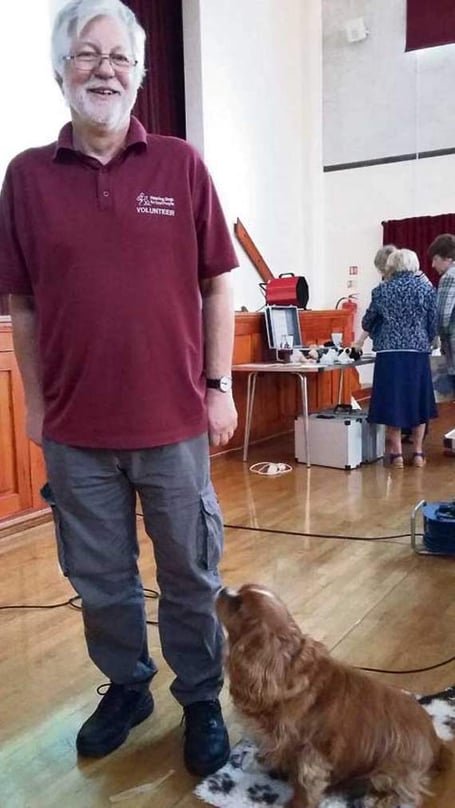
THE speaker at last month’s Bude and District U3A was Bryan Hollingsworth, representing the charity, Hearing Dogs for the Deaf, which provides assistance dogs for people with complete or severe hearing loss.
His companion, ‘Trusty’ the Cavalier King Charles Spaniel, had been the first puppy to stay with Bryan and his wife when they first got involved with the charity after Bryan’s mother went deaf.
Puppies, which are specially bred for the work, are socialised in a family environment before being trained. The group was very surprised to hear that Trusty had failed his training through being ‘too grumpy’, so he had returned to the Hollingsworths as a pet where he proved loyal — and apparently cheerful.
The group heard that one in six people of all ages experience hearing problems and suffer the isolation of a world without sound, but practically all find that having an assistance dog gives them independence and confidence, as well as companionship.

The charity was launched at Crufts in 1982 and the Princess Royal became its patron in 1992. The first demonstration dog was a terrier called ‘Favour’, who excelled at PR and was popular with the public. However, terriers were too independent for this type of training, and the breeds preferred now are poodles, labradors, retrievers and spaniels, all of whom love to work.
Puppies are sent to be socialised at eight weeks, and taken to places that recipients may live and work, so that they experience offices, noise, traffic, car travel, visiting shops and fairgrounds, football matches and more. The only place where an assistance dog may not legally go is a hospital operating theatre.
Bryan told the members how dogs are trained in the specific signals, which enable them to alert and communicate — normally a nudge with the nose or placing of a paw, but in the case of immediate danger the dog will lie down in front of the person to indicate ‘don’t go there’.
There are approximately 400 applications each year to be a recipient of an assistance dog, but only 100 dogs available, so it takes about two years to work up the waiting list. Applicants fill in a detailed form dealing with all aspects of their lifestyle, so they can be matched with a dog of a suitable temperament and experience.
The training centres have mock-up maisonettes, where the applicant and dog stay for a week to get to know each other in a home environment, under supervision of a trainer. The trainer will stay in regular contact for six months as emergency back up, but the involvement of the charity lasts for the lifetime of the dog, which remains under their ownership.
A dog’s working life is ten years, after which, or if the hearing-impaired recipient should die meanwhile, a foster home will be found by the charity. Each puppy costs £25,000 to train. There is no government funding available so volunteers are always needed, especially to provide foster homes for retired assistance dogs. Bryan said that the charity has not so far been particularly active in Cornwall, but that it is hoped this will change in future.
After meeting Trusty, some U3A members will be waiting with interest for some news of fostering opportunities.
Next month there will be a coffee morning on Friday, May 5, at The Weir, and at the Brendon Arms on Wednesday, May 17, both from 10.30am until 12.30pm.
Coffee and Company at the Brendon is judged to have been a success, but more people are always welcome.
The next open meeting will be on the following day, on Thursday, May 18, at the Parkhouse Centre, and will feature a presentation by the drama group of the winning play from a recent creative writing group competition.
The group looks forward to in-house culture produced by home-grown talent and hope it will be very well supported. For any further information, visit www.budeu3a.co.uk or contact Ann Tizzard, membership secretary, on 01409 253 749.
Comments
This article has no comments yet. Be the first to leave a comment.