
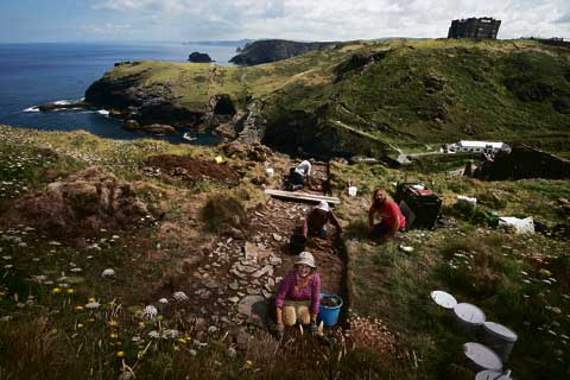
A NEW archaeological project has taken place at Tintagel Castle in a quest to find out more about the historic site from 5th to 7th centuries AD.
Onsite excavation and cutting edge techniques were implemented in the first major research project held at Tintagel for nearly 20 years.
English Heritage appointed Cornwall Archaeological Unit (CAU), part of Cornwall Council, to work on the project.
The first phase of excavations began on July 18, and ran until August 2. Four trenches had already been dug in two previously unexcavated terrace areas if the island settlement.


.png?width=209&height=140&crop=209:145,smart&quality=75)
It is hoped research into these carefully chosen areas will reveal more about how the people of Tintagel lived in the post-Roman period.
The terraces include buildings believed to date from 5th to 7th centuries AD. Throughout the excavations English Heritage hope to discover evidence for how and when the buildings were built — as well as what they may have been used for.
The trenches are named Tristan and Iseult, on the upper eastern terrace, and Geraint and Mark, on the southern terrace. They have so far revealed the first glimpse of stonewalls of buildings. The team’s next challenge is to establish the age of this ancient wall.
Tintagel is a very important archaeological site as previous excavations have uncovered thousands of pieces of pottery, with the vast majority dating from the 5th to 7th centuries and imported from the Mediterranean.
Finds in the four trenches have included sherds of imported late-Roman amphorae, which are fragments of fine glass, and a rim of Phocaean red-slip ware, discovered on the southern terrace it is the first sherd of fine tableware found on this side of Tintagel Island.
The journey into Tintagel’s past will continue long after the excavations draw to a close this summer, thanks to the use of cutting edge scientific techniques.
Samples of soil, ceramics, glass, iron, bone and molluscs will be collected and sent for analysis, and tiny samples of carbon will be used for accurate radiocarbon dating.
English Heritage’s properties curator for the west, Win Scutt, said of the excavations: “This is the most significant archaeological project at Tintagel since the 1990s. The three-week dig this summer is the first step in a five-year research programme to answer some key questions about Tintagel and Cornwall’s past.
“We’re cutting a small window into the site’s history, to guide wider excavations next year. We’ll also be gathering samples for analysis. It’s when these samples are studied in the laboratory that the fun really starts, and we’ll begin to unearth Tintagel’s secrets.”
A team of archaeological scientists from around the UK were enlisted to work on the project. The excavation team, directed by principal archaeologist at Cornwall Archaeology Unit, Jacky Nowakowski, worked with specialists from Historic England, geophysicists from TigerGeo Ltd, and experts on this period in Britain.
Jacky Nowakowski of CAU said: “CAU are very excited to be involved in English Heritage’s research project at Tintagel. This new archaeological research project will investigate unexplored areas of the Island in order to find out more about the character of the buildings on this significant post-Roman settlement at Tintagel.
“It is a great opportunity to shed new light on a familiar yet infinitely complex site where there is still much to learn and to contribute to active research of a major site of international significance in Cornwall.
“Our excavations are underway now, and will run both this summer and next, giving visitors the chance to see and hear at first hand new discoveries being made and share in the excitement of the excavations.”
Comments
This article has no comments yet. Be the first to leave a comment.