
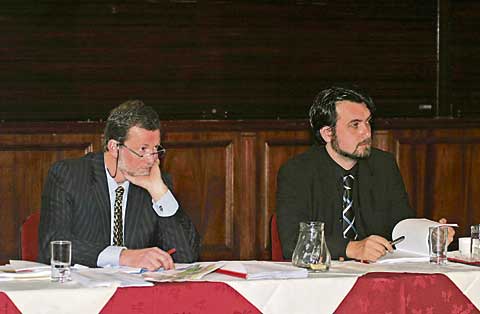
AFTER four days of hearing reasons for and against, public consultations and attendance of a site meeting, the public inquiry into the appeal by Catesby Property Group against Cornwall Council's refusal to grant planning go-ahead for its Binhamy development ended on Friday (March 19).
The proposed Binhamy Farm development, if given the go-ahead, would consist of mixed use development comprising 350 houses (including affordable housing), employment, retirement village (77 sheltered homes), extra care facility, retail (discount food and non-food), land for a new community building, public open space and landscaping.
The appeal which began on Tuesday, March 16, was being heard by Mr Harold R Stephens who represented the Secretary of State and who would eventually make the final decision on whether the Binhamy development, which had once been refused in August 2009, would be given the permission needed.
Tuesday, March 16 saw an outline of information from both parties and a summary from Mark Andrews, Cornwall Council's first witness.

.jpg?width=209&height=140&crop=209:145,smart&quality=75)
Representing Catesby Property Group for the four days was Barrister Jeremy Cahill, QC, and representing Cornwall Council was Barrister Adrian Trevelyan Thomas.
It was explained that there had been 43 replies in regards to the planning application. The itinerary of the week included a statement of common ground between the parties, an outline of the appellant's case, council's 'advocate' and witnesses, questions from members of the public and finally, closing submissions.
Witnesses appointed by Cornwall Council were Steven Swan (Director of Swan Paul Partnership, Chartered Landscape Architects); Cllr Nathan Bale (Cornwall Councillor for Bude North and Stratton) and planning inspector Mark Vivian Andrews.
Mr Thomas explained that with dormice being present in the hedges at the proposed Binhamy Farm site, this was a concern. However, Mr Cahill explained that the dormice would be provided with an alternative and therefore it was not a reason to determine the case.
One of the four main refusal reasons that Cornwall Council were against the proposed development was that of the 'adverse affect upon the area, including the loss of the gap between the two settlements — Bude and Stratton — to coalesce to the detriment of their individual identities.'
Examples of other similar cases around the UK were given by both parties to support their evidence. Previous reports and documents from the past were discussed, for example site conditions from 1997.
Amongst other reasons, Mr Cahill supported Catesby's case with the fact that the council have stated 13,400 new homes have to be built in North Cornwall by 2026. This was an large increase from the 5,100 stated by Cornwall County Council in 2004.
However, Mr Thomas explained that there was an absence of land supply and this proposal was put forward by Cornwall County Council and the new council should be given the opportunity to enquire in their own time.
When concluding, Mr Cahill said: "Policies that are being relied upon in the refusal are outdated."
Over the course of the four days the reasons for and against were disputed by the two sides and on Friday, the concluding submissions were made by both sides in attempts to secure their case.
It was expected that a final decision would take 16 weeks to make.
Comments
This article has no comments yet. Be the first to leave a comment.