
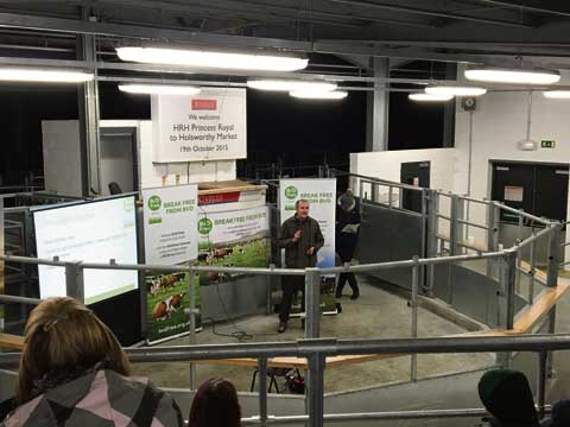
FARMERS and vets from across Devon came together on Thursday, January 12, in the ‘Dairy Ring’ at Holsworthy Cattle Market to show their support for a new drive to eradicate one of the biggest diseases currently affecting the UK cattle industry.
There were 45 in attendance on the say who all came to give their backing to the Agricultural and Horticultural Development Board’s (AHDB) new national scheme ‘BVDFree’. The scheme was launched last year in order to combat BVD, otherwise known as ‘Bovine Viral Diarrhoea’.
The scheme builds on the groundwork already in place to tackle BVD through successful initiatives including the CHeCS cattle health scheme and the South West Healthy Livestock Initiative.
BVD is an expensive, although often hidden disease, which affects half or more of all cattle farms in Devon. At the meeting, vets and farmers shared their experiences of losses through infertility, poor performance and mortality associated with BVD. The virus has evolved and can pass from one generation of cattle to the next — making it difficult to contain.
Lead veterinary science expert at AHDB Derek Armstrong explained that ‘BVD crosses the placenta in the first four months of pregnancy to infect calves in utero’, he added: “The virus has the ability to ‘hijack’ cells throughout the calf’s body, turning them into virus factories for the whole of the calf’s life.
“Once born these ‘Persistently Infected’ (PI) cattle are the main spreaders of the BVD disease and are both a key strength and the Achilles heel of the BVD virus.”
He explained that BVD is a ‘highly contagious viral disease’ and has become one of the biggest issues facing the UK cattle industry in recent years.
He said: “The national cost of this disease could be as high as £61-million a year, so it is vital that we work together to eradicate it.”
The strategy of the new scheme is to identify PI animals and remove them from a herd. Once the infected animal has been removed the virus cannot survive.
Event sponsor Ailsa Milnes, of Boehringer Ingelheim, outlined during the meeting at Holsworthy Cattle Market how farmers can keep their herds free of BVD.
The advice included buying only animals free of BVD, preventing nose-to-nose contact across fences and talking to vets about vaccinations.
The event also featured talks from Dan Forrester, from Penbode Vets, and farmer Mark Thomas on the benefits they have seen on farms that are tackling BVD. Mr Thomas said that some PI animals were only found to have BVD through testing, meaning they could have been spreading the disease without the farmer realising.
Veterinary surgeon Keira Moynihan and dairy farmer and veterinary nurse Becky Mills, both from Torch Vets, also stressed during the meeting the importance of testing for the virus and warned that one replacement calf or heifer, even one bought in good faith, could be PI with BVD.
Ms Mills said she had previously seen a group of calves in which some that were PI with BVD were 15kg lighter at the age of eight months than the uninfected calves of the same age.
Livestock auctioneer Mark Bromell, of Kivells, hosted the meeting at Holsworthy’s Cattle Market. He pointed out that trading livestock continues to make a key contribution to willing buyers and sellers in the 21st century.
He added that everyone wants to trade healthy animals and many of the major calf buyers, in particular, want cattle free of BVD and are willing to pay a premium for known BVD status.
Mr Armstrong concluded: “The aim of the BVDFree scheme is to make the next generation of cattle free of BVD for the next generation of cattle farmers. Farmers, vets and auctioneers in Devon have made it clear they are ready to play their part by making Devon a BVDFree zone.”
Mr Armstrong is now calling on farmers to register for the scheme and upload test results into the national database of the BVDFree scheme’s website — www.bvdfree.org.uk — which will allow farmers to buy animals that have been tested as BVD free and come from a herd with the ‘BVDFree’ status.
Comments
This article has no comments yet. Be the first to leave a comment.