
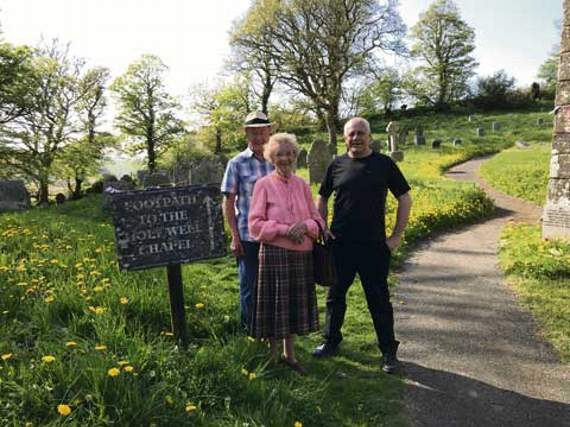
A FAMILY living around the Launceston area have been remembering their relatives — one of which was first and last to be christened by a very significant figure in the area, writes Rosie Cripps.
Ivor John Allin, Winifred Robbins (Wynn) and Phyllis Sleeman (Phyll) are all relatives of a man who was christened at St Clether holy well in 1899 by Sabine Baring-Gould, who penned the famous hymn Onward Christian Soldiers, and lived at Lewtrenchard Manor.
The child’s name was Thomas Henry Cleather Allin, and he would be the first — and last — baby to be christened at St Clether holy well by Baring-Gould.
Cornish historian and researcher, Barry West, held a special event over the May bank holiday, honouring the lives of both Baring-Gould and poet and author, Thomas Hardy.

Barry issued an appeal to find members of the Allin family on Facebook and was amazed to find several local family members, some of whom wrote down what they knew of their relation to Cleather in the visitors’ book Barry had provided over the weekend.
Recently, Barry arranged to meet at Ivor’s home in Launceston, along with Wynn and Phyll, to find out more about the family’s history.
Thomas Henry Cleather, known as Cleather throughout his life, was born to a poor family from Laneast in the late Victorian period. On September 14, 1899, Baring-Gould was delivering a service at St Clether holy well to a congregation of around 200, when Cleather’s parents begged him to christen their son.
Sat in the cosy living room of Ivor’s home, the family had countless photographs and documents detailing the Allin family line. Samuel Allin was head of the family, and was married to Annie Kate. Together they had five children — Cleather, Samuel John — known as Jack — two girls, Stephanie Lucinder and Elsie Ruth, and youngest son Leonard Theodore. Stephanie was Wynn’s mother, and Jack was Ivor’s father.
Ivor, 87, 93-year-old Wynn and 83-year-old Phyll are cousins — but there seems to have been a family feud, perhaps, because Ivor and Wynn’s version of ‘Allin’ differs to Phyll’s family name of ‘Allen’. The cousins think it may have been due to finances, but cannot be sure of this.
Born in 1873 at St Clether and 1874 at Treknow, Samuel and Annie Kate were married around 1898, aged 25 and 24-years-old.
Cleather, their eldest, was born in 1899, followed by Stephanie in 1902, Jack in 1904, Elsie in 1906 and Leonard in 1910 (approximately).
Samuel, grandfather to Ivor and Wynn, was a rabbit dealer — a trade that continued through the family during the first and second world wars.
Ivor said: “I only know this from what Uncle Len told me as a boy. During the war, there was a meat rationing — rabbit was a godsend! You’d have it about once a week, and his wife ran the farm.
“He (Samuel) had a contract with the government to trap rabbits, which would be killed and then sent to Lanson Station to be transported by train and distributed to wherever.”
Ivor joked: “No-one was veggie back then! You got what you were given.”
Phyll knows that her side of the family originate to St Clether, with her grandfather and grandmother, Harry and Marley Allen, living at Bramble Cottage. They owned the Hare and Hounds Pub at Laneast Down, and bred rabbits and pigeons to be killed and eaten.
Looking at two individual portraits of her grandparents, Phyll said that Harry and Marley were first cousins. Harry was the brother of Samuel Allin, and Marley would have been the cousin of Cleather and his siblings.
The family have a series of birth records, which show the date of when Cleather was christened at St Clether. He was registered as being christened on September 14, 1899 in the parish of St Clether, by Baring-Gould, rector of Lewtrenchard, born to the parents of Samuel and Annie Kate Allin from Laneast, who were labourers at the time — prior to Samuel’s trade in rabbit trapping.
It is believed the Allin family were living at Furse Park in Laneast up until 1911. The family also believe that there is a history of deafness running in the family, with questions asked in the 1901-1911 census to determine if a child is ‘deaf and dumb’, ‘blind’, ‘lunatic’ or ‘imbecile and feable-minded’.
A photograph (pictured right), taken at Coombe Gate Farm at Pipers Pool, shows the family in their Sunday best, standing sternly outdoors — a typical photograph of the era.
Ivor said: “Cleather once said to me that he wasn’t a great chapel-goer, but that Christianity was a good way to control civilisation.”
Barry then presented a story from a 1916 issue of the Launceston County Petty Sessions, giving an account of a family cousin, Henry Sleep Allin, who had been charged with damage to a granite seat. However, the story reads that Henry never appeared at the Guildhall for the case.
The article says: “Defendant did not appear, PC Berriman, who served the summons, stating that defendant told him he would not be there, and he was not afraid of him or anyone on the Launceston bench.”
Another scandal that Phyll reflected on was involving her grandfather at the Hare and Hounds Pub. She said: “During the time that my great grandfather owned the Hare and Hounds Pub, it is believed that he would sometimes water down the beer. Back then, because of the deliveries, I think they would have to water it down sometimes.”
It was also said at some time in the past that there had been a cockpit. Phyll continued: “They had a cockpit for cockfighting, and bred pigeons next door to the pub for food too.”
She has a photograph of some of the family members in the forefront of the pub, where a building is attached next to it with a series of pigeon holes at the top.
Ivor is a well-known character across the Launceston area. He started as a telegraph messenger at the Launceston Post Office at the age of 16, and after 43 years in the role became manager of the Royal Mail for Launceston and district.
Wynn went to work at Hepworth’s when she was 18 — and is still working for the modern David Parish Menswear establishment in its place at the age of 93, doing the alterations.
Phyll, on the other hand, said: “My grandparents lived at Bramble Cottage, and I can just remember Cleather Allin. I must have been about seven or eight years old, and I went to St Clether School, which is now a private residence.”
The three cousins attended Barry’s event last month, where a procession marched up to St Clether holy well — as a community beforehand would have in 1899 when their uncle was christened.
At the ages of 93, 87 and 83, the trio marched to the holy well just as well as anyone else.
Barry said: “In your family, or outside, how many people knew that Cleather was christened by Sabine Baring-Gould at St Clether?”
Ivor said that he knew of the family connections to the area, but Wynn stated that she didn’t have a clue!
“Isn’t it amazing that Cleather was the first and last baby since 1899 to be christened there, until my granddaughter’s christening?” Barry continued.
Three-year-old Lyla Rae, Barry’s granddaughter, was christened on Sunday, May 6 at St Clether holy well at a service led by Methodist minister Doreen Sparey-Delacassa. Ivor, Wynn and Phyll were delighted to be a part of the day.
Barry said: “On that same day in 1899, the congregation marched from the church at 3pm, led by Sabine Baring-Gould, and they marched through the gorse. There were 200 people there, and they sang hymns. Sabine told the story of St Clether, when a poor family came and begged to have their baby christened — and that was when Thomas was christened ‘Cleather’.”
Ivor said: “But the Allin family doesn’t finish with us. It will finish with my two granddaughters, when or if they get married one day.
“When Cleather passed away, he was cremated and had a plaque put on the wall for 25 years at Weston Mill in Plymouth.
“Cleather didn’t have any children. He was very tall, about six foot, and he lost all his hair — another Allin family trait!”
Cleather would go on to farm sheep near Minions later on in life, and lived near the ‘cheese ring’ at Cotts Farm. However, during his younger years, he worked for the council doing highway maintenance jobs.
Ivor said: “He didn’t do much work on the farm; he worked for the council, and would go off on horse and cart to dig ditches and fill in holes in the Laneast area.”
Jack, Stephanie and Annie Kate would work the farm. Ivor continued: “Elsie didn’t do much on the farm. Stephanie would always say, ‘she never done much, she was up in her room with paint and powder’!”
Comments
This article has no comments yet. Be the first to leave a comment.