
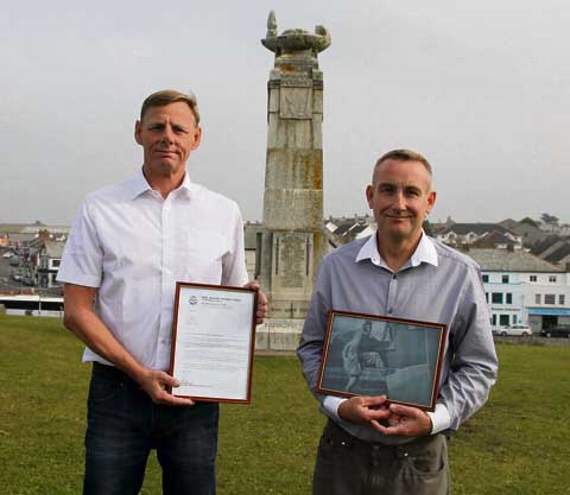
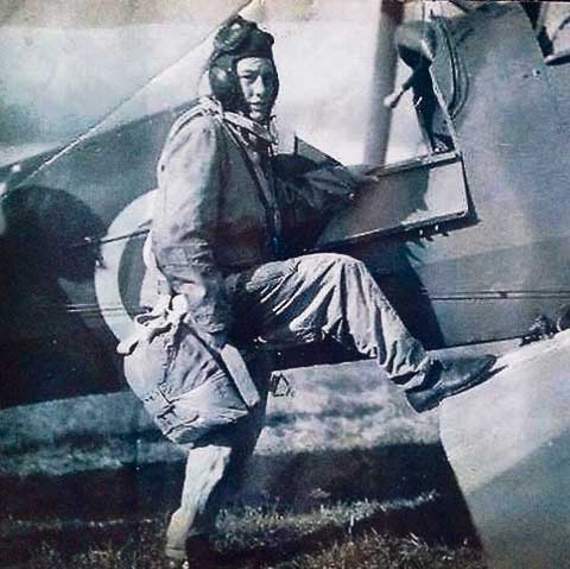
IT IS 76 years since a New Zealand RAF pilot died after crashing into the sea when he attempted to land his plane on a Bude beach — but two town residents are making sure his memory is not forgotten, in this country or his own, writes Ryan Cox.
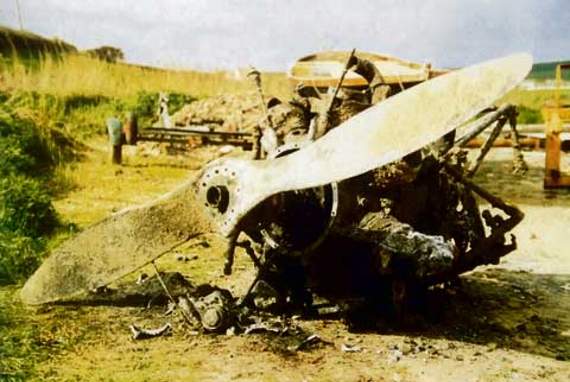
On a chance visit to Davidstow Moor RAF Memorial Museum last year, Dominic Owen and David Cross came across an old engine alongside a newspaper article that explained the engine was from a World War Two aircraft, flown by Pilot Officer Joseph Wendell Boreham, 24, from Dunedin, New Zealand, which crashed in the sea after attempting to land on Summerleaze Beach.
The article explained that the plane was an Avro Anson, serial number 5055, and it was flying from St Athan, South Wales, on a night navigation exercise.
Dominic said: “We believe that Joseph Wendell was an experienced pilot, who was re-teaching an old pilot navigation skills when one of the engines on the plane packed in — you can’t fly an Anson on one engine alone, unlike planes like bombers, so they lost altitude.

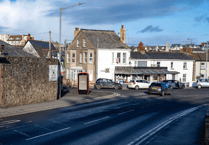

“Unfortunately it was too low to land at the former RAF Cleave Camp, about two miles north of Bude, so he decided to follow the coast as they do when it’s bad weather, because it was quite a stormy night apparently. On seeing the beach at Summerleaze, he mistook the surf line for the sand, therefore the plane basically just landed in the sea.
“Four crewmen survived the landing, they all survived; they went to a dinghy. On getting in it, they noticed they didn’t have a paddle, so Joseph volunteered to go back to get the paddle or some other implement to steer the guys back to the safety of the beach. Unfortunately, when he returned to the plane which hadn’t quite sunk yet, he retrieved the paddle, but as he was coming out, a wave took him and he was never seen again.”
The incident happened just a month into the war in October 1939, making him the first New Zealand RAF member to be killed in World War Two. The other three crew members survived that day, but two went on to be casualties of war, with just one surviving.
The plane itself was discovered in 1991 while sewage works were being carried out in Bude. Local fishermen helped recover the aircraft and it is from there that the engine ended up in the RAF Memorial Museum at Davidstow.
Taken up by the reference to Bude in the article, Londoner Dominic, who has lived in the town for 30 years, spoke to friends about the story and as it was approaching the anniversary of Plt Officer Boreham’s death, shortly after the museum visit, he and David threw some flowers into the sea in memory of the airman.
When asked by passersby what the flowers were for, Dominic shared the story and was encouraged to try to see if he could get in touch with any of Plt Officer Boreham’s relatives, — that’s when the ‘project’ really took off.
On Armistice Day, Dominic and David placed a poppy cross at Bude War Memorial, alongside a laminated sheet with a picture of the pilot and the story, so that he would be remembered among all the other servicemen on Remembrance Sunday.
Dominic wrote to the New Zealand Embassy. It was unable to help with the request to trace relatives, but he did receive a certificate of thanks from the current Wing Commander of the New Zealand Defence Force for remembering the airman.
After several letters to the Mayor of Dunedin’s office with no response, Dominic received a letter from Plt Officer Boreham’s nephew, Peter Boreham, who explained he had been passed on the letters sent to the mayor.
Since making contact with the relatives, Dominic has had an ongoing correspondence with them.
Since the initial connection was made with them, the original letter from Dominic has been read out in assemblies across schools in Dunedin as well as on local radio. Plt Officer Boreham’s old school wrote thanking him for bringing the story to light and inspiring its pupils.
Dominic has been busy in Bude, talking to everyone and anyone who may know a little more, and after speaking to local fisherman Charles Penwarden, who was there in 1991 when the plane was recovered, he was able to provide photos of the day as well as a piece of the engine.
Dominic said: “When I went to see him about the crash, he dug some old pictures out and a piece of the aircraft and said he’d like me to have it to pass on that part of the engine to the family.”
Charles believes the propeller of the aircraft is still somewhere in the Bude and Stratton area and Dominic and David would welcome anyone who knows of its whereabouts to get in touch.
The pair are currently preparing a package to send to the relatives in New Zealand, with part of the aircraft’s engine, a video of Bude showing the coast he would have flown over, other old documents, including a letter from his commander from 1936 wishing him luck in the war, and a Cornish flag to remember Pilot Officer Joseph Wendell Boreham, who Dominic said was ‘forever in Cornwall’.