
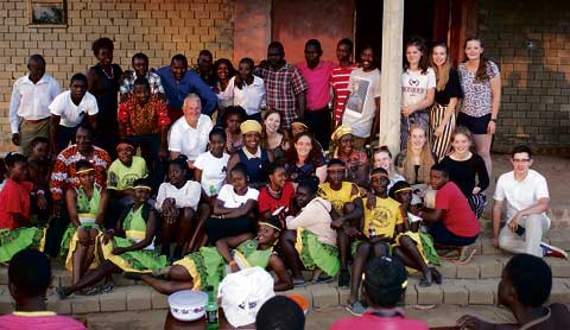
IN July Launceston College staff took a group of seven students to visit the college’s global partner school in Uganda — by all accounts a life changing trip.
Bunjakko Island Vocational School opened in February this year after relocating from the centre of Kampala and was previously known as Kibuye High School.
The school is located in a rural location, which has yet to receive electricity and water supplies, but is built in a stunning location on the banks of Lake Victoria.
The students had worked hard before the visit to raise money to take to help improve the school and living conditions for the students.
The Launceston College group — including students Lola Springbett, Lydia Duke, Courtney Whiting, Megan March, Jess Hill, Evie Asmand, Joe Dickinson and staff Mrs Emma Thompson, Miss Shelley Carew and Mr Bryan Maywood — were able to buy solar panels, paint classrooms, build fences and a piggery, buy nine pigs, teach ballet, drama and much more.
They organised a very emotional and joyful party where they presented 115 textbooks, awarded five scholarships, and where the students all enjoyed a meal and cake.
The trip was described as ‘incredible’, with no one wanting to return home.
Principal Bryan Maywood recounted his experience: “I cannot hide the anxiety I felt before our trip — how many things might go wrong when taking seven young people into the heart of Africa? Uganda, just next door to Rwanda, where images from 20 years ago still haunt my mind. But since Richard Lander School had been making this trip for many years I knew my worries were more tricks of the mind and nothing to do with reality. And so it proved.
“I could write an essay, multiple essays even, on what I, and we, our magnificent seven students, learnt, by living with Ugandan students and staff for a week.
“I think what I learned most is how having everything does not bring joy; the joy of the students in Africa was inspiring, and that was a joy despite a life that materially contained virtually nothing — just a box on a triple bunkbed. There was a joy in talking, smiling, laughing, spending time with each other — and with wanting to learn as much as could possibly be learnt, despite the only educational aid being a scratched and ineffective chalkboard.
“On five mornings I ran along the red dusty road between 6am and 7am in the morning, accompanied by one or two sixth formers. Motorbikes and trucks occasionally passed by in a cloud of dust and we overtook men on their way to work, machete in hand for a day cutting cane.
“As each day passed more families and youngsters would stand in the road and wait for the ‘Mzungu’ (white man) to run past — and to shout ‘Oli Otya’ (hello). I ended up in a primary school, meeting fisherman and random folk collecting water from the water pumps dotted every half mile or so along the dusty road. Everywhere there was warmth and humanity; we are all changed forever.”
One of the students from Launceston College said: “Uganda was amazing, there was so much culture and it really widened our knowledge of the world around us. One of our first projects was to paint the classrooms, we put on a base coat and then we painted on a massive periodic table that was the same size as one of the walls.
“None of the children in the school had ever done finger painting before, so myself and Lola painted their hands and we made a massive hand print mural on the wall with loads of hand prints on. It was amazing seeing their faces light up when the cold paint was on their hands for the first time and they had just created something on the wall that will be with them forever.
“I got to help out with a senior 5 class with maths, Mr Maywood wrote an equation on the board from my previous exam and no one could get it so I went through it with them on the chalk board and they were all crowding around me to see what I was doing.
“After that, we went through simplifying fractions and more equations. It was amazing to see the ambition that every student had at Bunjakko, everyone had future goals: engineers, doctors, accountants, geologists, everyone valued their education so much and wanted to make a difference.
“One student, John really wanted to learn Spanish as he found it fascinating that we get to learn it at school so he wrote a list of words and phrases he wanted to know and got us to translate them; we’re hoping to send him over a Spanish book for him to learn more.”
Another student said: “I decided today [July 26] I would focus mainly on the girls. I began by finishing to distribute the remaining bras to the girls, I never realised how much something we take massively for granted would mean for these girls, I couldn’t help but feel an overwhelming feeling of pride whilst educating the girls on how to correctly wear the bras (this was something they’d never been told before) and this mini lesson sparked a bigger idea, to have a girl talk.
“Over the week we’d all noticed small things which we felt needed to change, for example many girls hadn’t been taught about hygiene and looking after themselves as well as how to use a tampon, with many not even knowing what they were!”
Comments
This article has no comments yet. Be the first to leave a comment.