
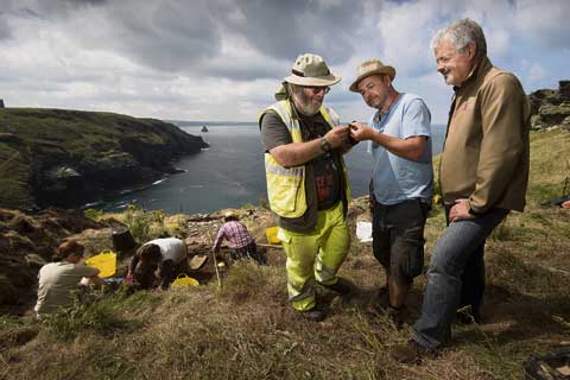
AN archaeological dig that took place in Tintagel over the summer, with hopes it would reveal more information about medieval Britain, was featured on the most recent episode of Digging For Britain on BBC2.
Tintagel is an area of Cornwall that is already widely renowned for its rich history. With the legend of King Arthur — who is believed to have been conceived in Tintagel, and, if there is any truth to it, was a great soldier in the 5th or 6th century — archaeologists were not expecting to unearth such a vast array of dark age findings.
Hosted by Professor Alice Roberts, Dig For Britain aired on Tuesday, December 6 at 9pm on BBC2, and showed viewers different archaeological digs that have recently been carried out across the UK, including the dig in Tintagel, where archaeologists investigated the town’s rich dark age history.
As part of the five-year English Heritage research project, experts from English Heritage and the Cornwall Archaeological Unit have previously discovered that Tintagel once contained a large dark age settlement, from around 600AD.



This year, from Monday, July 18 to Tuesday, August 2, a team of archaeologists and experts returned for a three-week excavation to explore areas around Tintagel Castle that had never been dug before, and were immediately taken by surprise as soon as they started their dig.
Starting their dig behind Tintagel Castle, the team opened up four trenches in a space — two on the southern terrace and two on the eastern side of the headland — in the hope that they would come across some dark age buildings.
Viewers watched the team come across three distinct terraces within the first few days, but had no such luck finding any walls to determine that these were once buildings, coming to the conclusion that they were perhaps conservation plots.
However, shortly after, the team unearthed another three terraces and walls, with steps leading up to, what would have been, the top building — an incredible first breakthrough, with Professor Roberts saying: “Never before has such a solid dark age building been discovered in Britain.”
Viewers saw the team find a rubbish pit next to the building, with remains of animals — perhaps boars and pigs — buried within it, suggesting the residents of this building could have hosted many dark age feasts.
As the archaeologists continued their dig, other findings established that the building was of a high status.
A fragment of pottery, which would have once been used as a fine table dish — perhaps used for pieces of fruit — was unearthed in the dig. Archaeologists concluded that it would have been a large, shallow bowl that would have come from Turkey, and would have been used at communal feasts.
Another find, a rare piece of glass dating back to the post Roman period, was thought to have once been a wine glass, and would have originated from France.
Furthermore, a large handle of an amphorae was also discovered. During its time, it would have been used to hold olive oil or expensive and fine wines, which would have travelled from countries such as Turkey and Spain.
These high quality foreign goods suggest that the residents of this home were wealthy and powerful, being able to trade from afar for the finest things. However, archaeologists were hesitant to confirm that the findings were the remains of an early dark age palace, but were quite certain that it could have been a place of wealth and high status.
Viewers heard one of the archaeologists say, ‘we can’t be certain that it is a royal site, but whatever it was, it was a high status site’.
The building, measured at eleven metres long and four metres wide, dates back to a time just after the collapse of the Roman Empire, when Britain began breaking off into ‘independent states’, according to Professor Roberts.
Archaeologist and senior properties historian for English Heritage, Susan Greaney, wrote a blog, following the team’s discoveries at Tintagel. In the blog, she explains the team’s aims, what they did and what they found.
Susan said: “Previous excavations at Tintagel have revealed the outlines of some of these buildings, and provided evidence of far-flung connections.
“Sherds of amphorae, pieces of fine plates and bowls, and fragments of decorated glass vessels show that people living here were trading with the Mediterranean world. More of this sort of material has been found at Tintagel than any other site in Britain. We therefore assume that this was a high-status settlement, possibly seasonally occupied by regional leaders or kings of Dumnonia.”
Following the dig, the findings were sent to a lab for further analysis and investigation until January 2017, when they will then be examined by expert historians.
It is expected more information about the findings will be released in the spring of next year, in hopes it will reveal more information about Britain’s heritage and Tintagel’s legendary past.
To read Susan’s blog, visit http://blog.english-heritage.org.uk/discoveries-excavations-tintagel-castle.
Comments
This article has no comments yet. Be the first to leave a comment.