

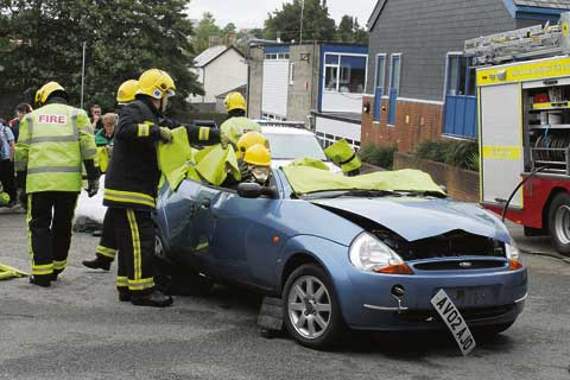
LEARNING how to stay safe, the Holsworthy Fire Station crew held a demonstration for pupils of Holsworthy Community College to show them just how they would go about freeing a casualty of a crash — providing an insight into the consequences of poor road safety.
This was the 10th Road Safety Awareness Day held at Holsworthy Community College. On Wednesday, June 29, the pupils spent the day attending workshops and learning the risks involved with driving, being a passenger and even being a pedestrian.
After returning from a real call out to an incident minutes before they were scheduled to start, fire crews, accompanied by St Johns Ambulance and Holsworthy Police, rounded off the day with a demonstration, simulating cutting one volunteer out of a car that had been in a ‘crash’.
Student Jasmine Greenaway volunteered to be the ‘casualty’ who needed rescuing from the vehicle.



Rushing onto the scene were firefighters David Goodman, Russell Sharman, Henry Mann and PFCSO Mark James, all ably driven in by firefighter and driver Matthew Fiddy, with crew manager Craig Darby leading the exercise.
With the fire engines lights flashing, they acted out in real time what the procedure would be for a person trapped in a crashed vehicle with suspected neck or spinal injuries.
Watch manager John Nolan, who works for the group support team, aided the demonstration with commentary.
Mr Nolan asked the pupils ‘What do we think is the best option to get her out?’
A student replied ‘cut her out’.
One member of the crew then positioned them self behind the drivers side seat and held Jasmine’s head in place to ‘prevent further injury’ before placing a collar around her neck, all whilst another spoke to the ‘casualty’ to keep her calm.
Mr Nolan said that this was because they were ‘simulating a spinal injury where the passenger had hit their head on the windscreen and was wearing no seat belt’ adding: “Which we will remember from earlier on, is a reason you should always wear your seatbelt.”
He then talked the pupils through the next steps of the process.
The team placed a plastic sheet over and around those inside the vehicle, this was to protect them from any shattering glass as the fire crews began to saw into the front windscreen.
Mr Nolan said: “If the casualty has any open injuries they are at risk of getting more glass in that wound. This would then have to be scraped and washed out at the hospital. We want to avoid unnecessary injuries like this so will cover the girl with the plastic sheet.”
The plastic sheet is referred to as ‘soft protection’ and a plastic teardrop shape board is also used as ‘hard protection’ to stop flyaway shards of metal or glass hitting the casualty inside the car.
A print out sheet was handed to crew manager Craig Darby, with details of the car gained by running the number plates. From this information they were able to decipher whether the vehicle was safe to continue working on.
Then, using hydraulically powered ‘spreaders’, they where able to prize open the bonnet to disconnect the battery as Mr Nolan said: “They are looking to disconnect the battery in order to minimize the danger to the casualty and the guys.”
Mr Nolan then talked the pupils through how the Ford Ka car was going to be ‘turned into a convertible’ in order to safely remove the casualty from the vehicle.
They used a saw to cut through the glass, spraying it gently with the water hose to wash away any glass shards.
Then, using hydraulic cutters, sometimes known as the ‘Jaws of Life’, they sliced through the metal posts of the Ford Ka like butter, moving there way systematically around the car until the whole roof had been removed.
Magnetic covers were placed over the sharp edges that had been freshly cut to prevent further injury to the casualty or the crew.
Mr Nolan reminded the pupils that this was only a mock up of what a real event would be like, he said: “We have to bare in mind that this could all be happening in the middle of the night or down a narrow country lane or even on a motorway with cars driving past. Our main priority is of course to get the casualty out safely, but we also have to ensure the safety of our crew.”
The crews then worked swiftly, but carefully, to hoist Jasmine out of the car and onto a spinal board, being cautious not to move her spine or neck, and working as a team they pulled her up safely six inches at a time.
After being cut free from the car, Jasmine Greenaway told the Post about her experience saying it was ‘fine’ but when asked if it had been scary being cut out of the car she adding: “It was not too bad but was kind of scary, yeah.”
Speaking on the reasons they visit the school each year to perform this demonstration and hold the Road Safety Awareness Day, watch manager John Nolan, said: “I have been working in the fire service for 29 years and have been with Devon and Somerset fire and Rescue for 15 of those years, I was at Berkshire before, and in that time have gained a fair amount of knowledge that I am now able to pass on to the younger generation.
“We hold this Road Safety Awareness Day each year at the school as it is all about passing information on to the youngsters because they are the ones that can make a difference.”
The pupils were informed of how they can be the change and that they have the power to ask a parent, friend, boyfriend or girlfriend to slow down if they feel uncomfortable.
They were also shown the ‘My Red Thumb’ campaign, which tries to reduce the number of road traffic casualties by encouraging people to stop using their mobile phone whilst driving.
Mr Nolan said: “We try and influence the school age group, especially girls of around 14 and 15 because they are, usually, more likely to have older boyfriends of 17, 18 who will have just got their driving licenses.
“We emphasis during these sessions that if you are feeling uncomfortable with someone’s driving, for example if they are going to fast, have been drinking or taking drugs, then you are able to tell them to slow down or, if they persist, to ask them to stop so you can get out of the vehicle — also to not get in a car if someone has been drinking or taking drugs.
“We have also been informing them of the dangers of mobile phones whilst driving, and made sure they are aware that at the end of the day their life, and the life of their friends and family, is more important than a text or phone call — it only takes two seconds to misjudge a road and be in a fatal accident.“
After the car cutting demonstration Craig Darby, crew manager at Holsworthy Fire Station said: “There is a ‘text book’ way that you train for these situations but on the day it’s much different.
“We prepare for the text book way, that we showed today, of handling a situation but when a car has been damaged, tensions on it can cause other issues along with weather conditions and location, so this is just a taste of what we do, but every incident is different.”
For more information about the ‘My Red Thumb’ campaign or to get involved visit the website www.myredthumb.com
Comments
This article has no comments yet. Be the first to leave a comment.