
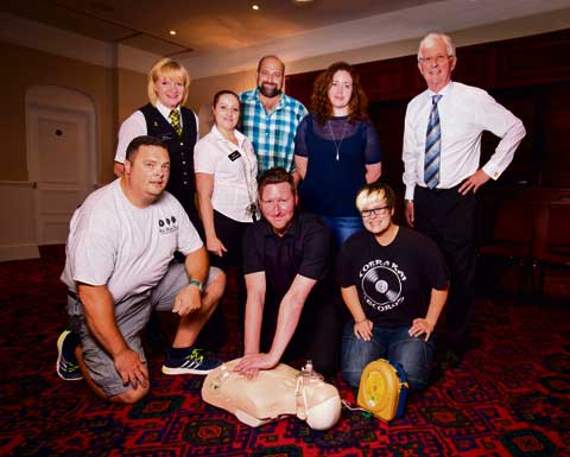
RUPERT Brendon, owner of the Falcon Hotel in Bude, has recently paid for an automated external defibrillator (AED) out of his own pocket, and the defibrillator is now available 24/7 for hotel residents and staff, as well as nearby neighbours.
An AED is an electronic device that analyses the heart rhythms, and, when the device detects, provides the shock needed for defibrillation.
The shock interrupts the chaotic rhythm and allows it to return to normal, but only if CPR is continuously applied before and after the shock to get the heart to pump normally again. CPR alone gives the patient just a 5% chance of survival. When CPR is combined with a shock from an AED, the survival rates can increase to more that 75%.
Sudden cardiac arrest is a condition in which the heart stops beating suddenly and unexpectedly, due to a malfunction in the heart’s electrical system. The malfunction that causes this is a life threatening abnormal rhythm, an arrhythmia.


The most common arrhythmia is ventricular fibrillation, which makes the heart’s rhythm so chaotic that the heart merely quivers, and is unable to pump blood to the body and brain. This is more commonly known as a heart attack.
Once the heart has entered ventricular fibrillation, a sudden cardiac arrest may occur. During sudden cardiac arrest, a victim first loses their pulse, then consciousness and finally, the ability to breathe.
All of this can happen within a matter of seconds. Sudden cardiac arrest strikes without warning and claims hundreds of thousands of lives around the world every year.
Comments
This article has no comments yet. Be the first to leave a comment.