
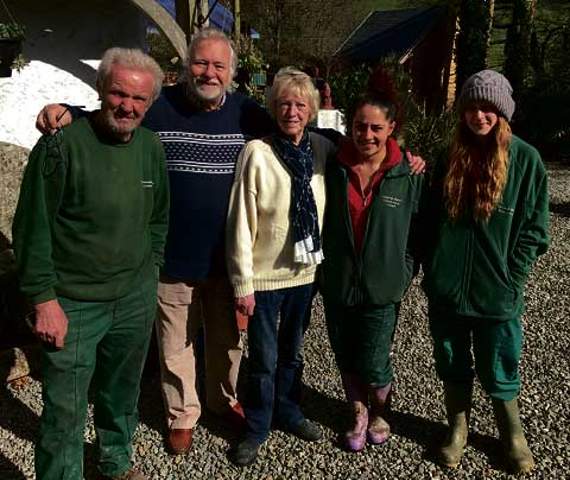
‘CONSERVATION is key’, is the message from the relatively young charity The Cornwall Nature Conservancy.
But despite the charity itself being only a couple of years old, there are decades of experience and passion behind it
At the helm of the charity, based near Launceston, is Antony Blackler, awarded an MBE in 2005 for services to conservation, and charity co-founder and wife Cherry, a retired special care baby nurse who continues her love of the young and small by rearing any distressed or injured animal and any of the charity’s own collection which need special help.
Cherry was one of the first four people to be awarded the Duke of Edinburgh’s award.

Tony has been a lifetime conservationist and amateur naturalist. His first pet at 18-months-old, unbeknownst to his parents, was a big fat toad!
Throughout his youth he rescued wild animals that were sick or injured from foxes to peregrine falcons and slow worms to barn owls.
Tucked well away from the busy A388 are the headquarters, Cherry and Tony’s home, where they head up a dedicated team, including office assistant Kim, keepers Lauren and Olivia and maintenance man Rab, who has made most of the enclosures on site.
And what a site it is. It is set in a ten-acre nature reserve, and there the humans have the pleasure of working with all sorts of beautiful creatures. They are looked after lovingly, and security is of utmost importance.
Tony assures that everything is completely above board — they never buy or sell, they are one of only eight private zoos that is a member of the British and Irish Associations of Zoos and Aquariums (BIAZA) and they abide by the same rules as London Zoo.
They have the dangerous animal licence, updated every three years and they are inspected every year.
Above all, Tony’s message is: “Nobody should look after these animals as pets.” He points to scars on his forehead and above his eyes that he received one Sunday morning from a three-month-old lynx to back up his point.
Tony and Cherry took on the derelict mill where the centre is based 35 years ago, and after they started to build enclosures, the first animals they had were Scottish wild cats.
They have set several free over the years, for their aim first and foremost is the conservation and care for rare and endangered British and worldwide animals, breeding them and being part of breeding programmes that are worthwhile and meaningful.
As well as the Scottish wild cats, they keep and breed, and on many occasions, release such British animals as European otters, water voles, harvest mice, pine martins, polecats and barn owls.
They are also committed to the breeding of worldwide cats, most of which have suffered from excesses of hunting and the fur trade. They keep pumas, lynx, ocelots, fishing cats, African servals, jaguarundi, rusty spotted cats, and leopard cats.
They will soon be sending two pumas, two lynx and two fishing cats to a 245ha botanical and zoological gardens in Panama.
They have already exported leopard cats to India and Scottish cats to Scotland.
There is also Lovejoy, the gorgeous baby puma, born on December 19, who currently has home set up in Tony and Cherry’s kitchen, alongside the toy fox that is bigger than she is.
Tony said: “At the end of the day we really are committed to conservation.
“All our animals we rescue, British mammals and breeds, we release where possible.”
There aren’t many British animals they keep, however, ‘Frankie’, the fox can’t be released as he has a hearing problem, but they have found a mate for him, and are currently extending Frankie’s house.
Among their worldwide cats, Tony has a serval given to him by a lady who paid several thousand pounds for him. He said: “There is an awful trade in these cats. If mated with a domestic cat they produce savannahs, which are very pretty cats but highly irregular. It’s a cruel situation; a lot of people have been influenced by fantastic amounts of money.
“Conservation is going a long way and beginning to move a bit but we have so much to fight.”
Their maintenance man, Rab, has brought up a happy, healthy serval, who now dotes on Rab. Stefan the serval was discovered in an enclosure by Tony and Cherry and looked like a ‘bundle of meat’.
“He was one per cent alive,” said Tony. He had a slash across his throat, and they hadn’t known the mother serval was pregnant.
Tony added: “It was clear, the father had swiped it when [the mother] was moving it from one nest box to another.”
They got him warm and Rab took him home, feeding him every few minutes and letting him sleep in his armpit. Rab was heartbroken the next day, as it still had maggots.
They kept his wound open for a fortnight to ensure it was clean, and he lived with Rab for months, sleeping in his bed. Originally named Stella, after Rab’s girlfriend he met while on safari, he became Stefan after they realised he was in fact a male!
Rab said: “I fed one end, hadn’t thought to look at the other!”
At the conservancy there is also Ozzi the ocelot. Run over by a logger in Nicaragua, Ozzi was taken to a rescue centre, and then sent to Berlin Zoo, which Tony notes, has the biggest collection of animals in the world as a city. There, unfortunately Ozzi started to eat himself, Tony adding: “He hated the public and noise.”
Ozzi came into the UK via one of Tony’s good friends at Exmoor Zoo, but unfortunately the ocelot continued to eat itself. Tony inherited Ozzi along with a £50 a month medical bill. Cherry recalled that mothers used to use a foul tasting nail treatment on their children to prevent them from biting their nails, and they purchased the most strong, organic antiseptic they could, sprayed it all over Ozzi, and within a fortnight he was clear, subject now to just ‘a nibble here and there’.
Tony sent a photo of Ozzi to his friend at Exmoor, who said he could stay at the conservancy, and Tony and Cherry are now trying to find a female for him.
There are so many more species they look after, including tortoises rescued by customs and excise after illegal entry to the UK.
They also have ‘tenrecs’ from Madagascar — which people often mistake for hedgehogs — rescued by the courts from a pet shop. They are interesting, as Tony explains, because in the evolution of mammals, tenrecs are the first non-egg laying.
Then there is the tame meerkat from Namibia, coatimundis from South America and yellow mongoose. While they are, as Cherry describes, ‘one of the best breeding zoos in the country’, there is also Piggleton the pig to look after, who loves grapes!
Once able to fit in a pint tankard, the now huge Piggleton was brought up by Lauren and Olivia. Tony said of Piggelton: “He has huge teeth and lives like a little lamb.
“We have the pig that begs, but our major aim is conservation of very rare creatures.”
Granted charitable status on August 4 2015, Tony said this was to try and secure the future of the conservancy, as at 72, he wanted to know the work would carry on after he could no longer do it. Tony and Cherry plan to leave their mill and nature reserve to the conservancy.
He said: “I still work at 72-years-old. We formed a charity two years ago because I can’t work forever and it does take an incredible amount of money.”
Those interested in their work can pay to become members of the conservancy, or to adopt an animal. Donations are also very welcome.
The cost to Tony and Cherry of looking after their collection is around £50,000 per year, and they are hoping for more individual and corporate members, so that the trustees can carry the conservancy forward when Tony and Cherry are no longer around.
Currently the costs are funded personally by Cherry and Tony, who works as an accountant.
Tony and Cherry count themselves lucky to have a wonderful team working with them.
Such is their gratitude, when Cherry had the chance to buy a new car, she decided to take three staff on safari to Kenya instead. The two keepers have also been to Lapland reindeer and husky skiing, thanks to Tony and Cherry.
Lauren, who travels in to work from Plymouth every day, said: “There are no words. It’s just the best job.”
Cherry sums it up: “We are barking mad on animals!”
As another key aim of the charity is education, Tony is more than happy to give lectures to groups, for a modest donation, and is willing to hear from anyone who is interested.
For more information on the charity and to find out how to get in touch, visit https://cornwallnatureconservancy.org.uk
Comments
This article has no comments yet. Be the first to leave a comment.