
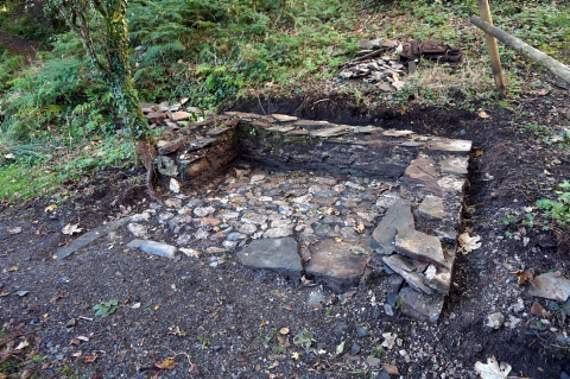
AN ARCHAEOLOGIST recently visited the Vale of Avalon/Arthurian Centre at Slaughterbridge, in order to uncover the remains of a cottage thought to be associated with the old North Cornwall railway line.
During the weekend of September 7 and 8, Nick Hanks from English Heritage visited the site near Camelford to look into suggestions that point to an old cottage that would have once stood there, with connections to the since bygone North Cornwall railway line.
The dig was part of the first season of this area of the site, with archaeologists ‘breaking new ground’ and discovering a different phase of the site between the medieval village of Melorn and Lady Falmouth’s garden excavated previously — an 18th century garden created by Lady Dowager Falmouth around the 6th century King Arthur’s stone.
Archaeologist Nick Hanks gave the Post an insight into the team’s findings, before a formal interim report was written up.
.jpeg?width=209&height=140&crop=209:145,smart&quality=75)


.jpeg?width=209&height=140&crop=209:145,smart&quality=75)
He said: “A small group of volunteers in just two long weekends have uncovered a lot in such a short space of time. More weekends are planned for 2020.
“The main focus of the excavation was the site of the cottage, which appears on maps at about the time the railway arrived in 1893. So we have the working assumption that this was the ticket office for visits to King Arthur’s stone.”
Nick said that the stone was already regularly visited before as the famous poetry of Alfred Lord Tennyson came about. His work, including the poem cycle ‘The Idylls of the King’ (1859-85), helped boost the popularity of the King Arthur story and Cornwall’s association with it.
He continued: “We are hoping as excavations continue to uncover finds connected with late Victorian tourism. So far finds have included pink and white beads from a child’s bracelet, an oval brooch cover, a little medicine bottle and a selection of marbles including ‘improvised’ marbles such as an old musket ball. One of the later guidebooks sold from the cottage does survive.
“A stepped path was rapidly uncovered and links the cottage to a former well and other structure excavated. This is better built than the rough foundations of the cottage, with a plastered wall that may have had shells stuck to it, for these were found in the rubble, and a shining white quartz floor.
“This may be an earlier structure adapted for use as a garden feature by those who lived in the cottage. Finds here included a blue enameled metal pot lid, a brass metal plate — possibly part of a harmonica — and a ceramic wheel which may have come from a tea trolley.”
Nick hopes that as they continue to expose more of this part of the site in future seasons of digging, teams may find parts of Lady Falmouth’s 18th century garden and buildings associated with Melorn, the medieval village excavated across the River Camel.
Comments
This article has no comments yet. Be the first to leave a comment.