
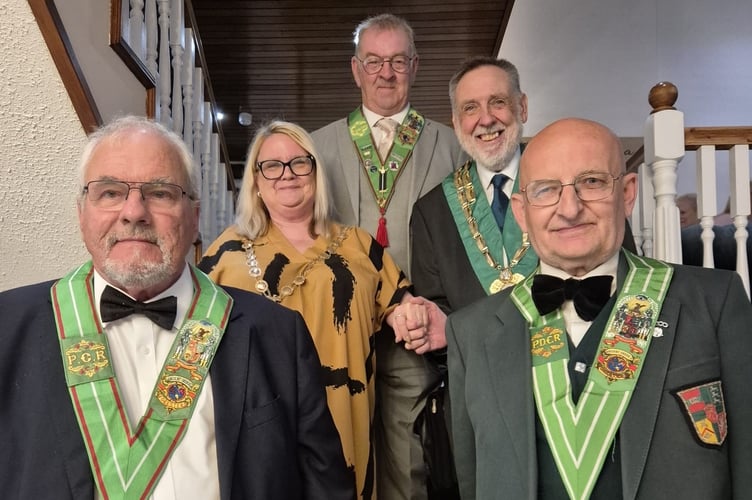
Foresters dinner and dance
MEMBERS of Cornwall’s two Foresters Courts came together for a spectacular dinner and dance event.
The occasion was jointly hosted by Kevin Wadland, chief ranger of East Cornwall’s Court Goodwill, and Mike Date, chief ranger of West Cornwall’s Court Pendennis.
West Looe’s Hannafore Point Hotel provided the setting for an unforgettable evening, which welcomed special guests of honour, the national high chief ranger Gail Lancaster, accompanied by immediate past high chief ranger Jo Andrew.

The event drew members from across the region, fostering a palpable sense of unity and fellowship. Following grace, guests enjoyed an exquisite dinner, after which the loyal toast was proposed, along with toasts to the two Cornwall courts, Pendennis and Goodwill.
Longstanding member Ken Thomas then shared a fascinating history of the society in Cornwall, highlighting the commitment of Foresters members.
A moving highlight came as high chief ranger Gail spoke passionately about her chosen charity, the Alzheimer’s Society. The Foresters’ ongoing support of world-class research into this debilitating illness was bolstered by a raffle at the event, which raised an impressive £300 for the cause.
The evening also featured a special surprise when a deeply moved Gail was presented with a Foresters heraldic badge, uniquely mounted in Cornwall by Ken.
As the night progressed, the dance floor came alive to the sound of live music, and generous donations continued to pour in to support Foresters’ community initiatives.
Foresters area secretary Gary Webber summed up the evening by saying: “Tonight has been about giving.
“Not only do we give back to our members, but we also give to local and national good causes. This is what being a member of the Foresters is all about. It has been a wonderful success and a pleasure to organise.”
Gary was met with a rapturous round of applause, receiving heartfelt thanks for his tireless dedication in making the event a resounding success.
Women’s Institute welcome florist back
Marhamchurch WI were pleased to welcome for the second time Helen Collier, the group’s favourite florist.
Helen, formally of Kings Hill Florist has move to a more suitable place in Kilkhampton and is now Underhill Florist at Underhill Cottage. The new premises mean Helen has more space for her business and a wonderful garden in which she hopes to grow lots of flowers to use in her bouquets and wreaths. Also on the cards is a plan to hold demonstrations with cream teas or wine for special birthday and or hen parties. Ladies at the meeting expressed great interest in being one of the groups to enjoy such an event.
At the meeting Helen showed us how to make a door wreath. Even members not au fait with floristry were delighted to be able to follow Helen’s clear instructions which resulted in a beautiful spring door wreath. Helen is determined to become as eco friendly as possible and the wreath was built using willow, picked during a dog walk, the packaging from delivered frozen dog food(loved by the birds for nest building) and twine instead of the usual florist wire.
Along with the wreath Helen managed to give members tips to assist arranging and extending the life of cut flowers as well as amusing tales of various disasters encountered during her life as a florist- mostly involving coming to the rescue after other peoples disasters.
Helen was kind enough to gift the wreath to the member whose birthday was closest to the date and Liz Vago was lucky enough to go home with the wreath.
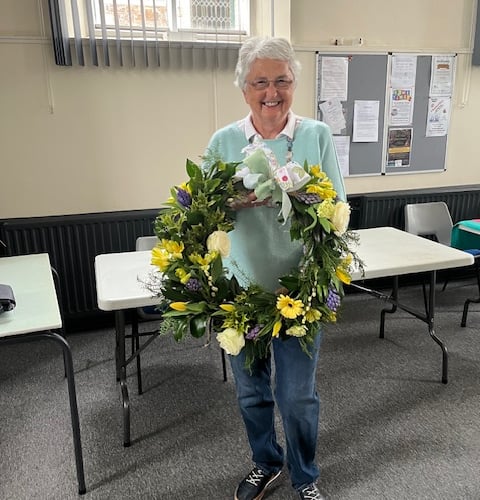
Helen was thanked by Mary Bromell and a round of applause from members who recommend giving Underhill florist a try. Helen can be contacted by phone, check out her Facebook page or website (still listed as King’s Hill Florist). Here’s hoping the in house demonstrations/parties take off soon.
Next month’s meeting is the annual meeting which will include this year’s WI resolutions.
Bude and District U3A
AN island where carnivorous plants lurk in bogs and birds secure their prey with spikes inside their beaks, only six minutes by helicopter from the North Devon coast.
Frances Stuart, environmental educator and volunteer Lundy ambassador, described the island’s wildlife and conservation work to an appreciative audience at Bude and District U3A’s April meeting.
Purchased by the National Trust in 1969, Lundy was then leased to the Landmark Trust. After restoring buildings, some of which are now holiday lets, the Landmark Trust runs the island in partnership with other conservation organisations. Two wardens live permanently on the island, and in the summer months MS Oldenburg brings tourists and supplies for the island’s inhabitants and animals.
Most of this three-and-a-half mile long outcrop of granite in the Bristol Channel is designated a Site of Special Scientific Interest (SSSI), with five animal and two plant species enjoying legal protection. There are forty one scheduled Ancient Monuments, the earliest dating from the Bronze Age, two protected shipwrecks and a Marine Protected Area round part of the coast.
All three species of gorse and the three species of heather found in the UK can be found on Lundy. There is also dry acidic grassland which must be grazed to control bracken and longer grass, allowing smaller plants like the carnivorous sundew to flourish, catching small insects to provide themselves with nitrates. Grazing animals include rabbits introduced by the Normans, Sika deer, Soay sheep which do not need shearing, feral ponies – a New Forest/Welsh mountain cross now recognised as a separate breed, highland cattle, and goats. All these animals eat different plants contributing in different ways to the health of the grassland. The grassland itself is monitored to ensure the balance is kept right.
The sea cliffs provide a different habitat, breeding sites for kittiwakes, guillemots, and razor bills, while puffins and Manx shearwater nest in burrows. Puffins can bring back to their burrows several sand eels at once, thanks to the spiky internal structure of their colourful beaks which hold the first catch in place while the bird captures more.
Rat predation was responsible for a serious decline in the numbers of both birds, but a project to remove them cleared the island within two years. Between 2002 and 2023, puffin numbers rose from 13 to 1,335 and shearwaters from 297 to 25,000. Total numbers of seabirds on Lundy in 2023 was more than 40,000. Over ninety percent of the global Manx shearwater population nests in the UK, making Lundy and the islands off Pembrokeshire very significant sites internationally. There are now measures in place to prevent rats returning. The seabirds on Lundy have not been affected by bird flu as yet.
350 lichen species thrive on Lundy, also the Lundy cabbage, found only on Lundy along with its companion insects, the Lundy cabbage weevil and the Lundy cabbage flea beetle!
Frances visits schools to prepare children before school daytrips. Last year schools competed to design tourist leaflets discouraging them from disturbing the grey seals. Grey seals, rarer worldwide than African elephants, need to rest out of the water one day in four to catch up on digestion and body repair that stops under water because of low oxygen. If panicked into escaping into the sea, they can injure themselves.
Visitors to Lundy face a steep walk from the jetty to the top of the island, but a Land Rover is available for those with mobility needs and there is a pub with a beer garden at the top. Volunteer guides are there to help visitors make the most of their time on Lundy. As U3A members thanked Frances for her talk, many said they would like to make the trip!
The annual plant sale also took place at the April meeting, and was very successful. At the next open meeting on May 21 at 2.30 pm. Edward Sheffield will talk about Mercy Ships – largest charity hospital ships in the word. Everyone is welcome. Full details of U3A groups and other activities are available at www.budeu3a.co.uk
Holsworthy Hamlets Flower Club
ANOTHER great evening was held at Holsworthy Hamlets Flower Club when Hannah Burnett from Plymouth was the demonstrator.
She gave a background to her career in floristry as she produced five arrangements interpreting her title 'Spring into Summer'
The first spring arrangement gave us yellow and red flaming parrot tulips, willow, moss and ferns. The next in a wicker basket contained purple calla lily's, lilac larkspur, and carnations, solomon seal and alliums. Going into summer a circular white container was the base for a crescent arrangement of many types of lilac and pink flowers arranged with ruscus, and eucalyptus. Moving into late summer we were treated to an oval container of fatsia and ruscus and with 'hot' flowers of strelitzia and proteas.
The chairman, Mrs Sylvia Harris thanked Hannah fort a most interesting and informative demonstration. Members were reminded that for the May meeting plantsman Alan French will be giving a talk.
Comments
This article has no comments yet. Be the first to leave a comment.