
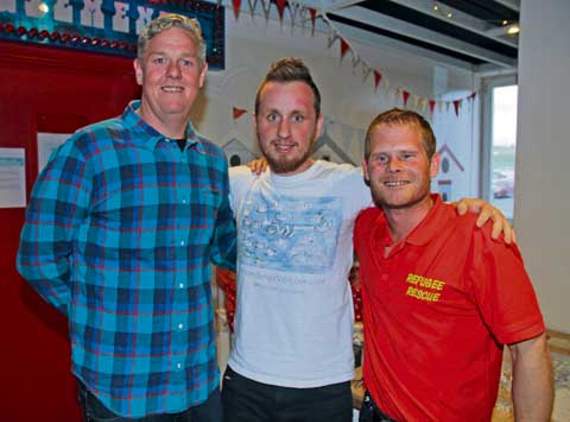
RYAN COX reports from Rosie’s Kitchen in Bude, where on the evening of Tuesday, April 5, over 150 people turned up to show their support for the ongoing refugee crisis, in what turned out to be a very emotional and thought-provoking event.
The evening was organised by Mary Whibley and the ‘Bude Welcomes Refugees’ group, and they had arranged for a Syrian student, who came to England to study at the University of Exeter, to explain how life was in Syria before the crisis and how it is now.
Two lifeguards from Bude were also invited to share their experiences after recently going to the Greek island of Lesvos to help the refugees who were traveling there dangerously for sanctuary.
With only standing room left, Mary got proceedings underway by first acknowledging the overwhelming support she had received from the people of Bude, highlighted by the shear mass in attendance on the evening who had filled Rosie’s Kitchen, and then she introduced Baraa Ehssan Kouja, a Syrian student from the University of Exeter who has just recently graduated from his Masters in IT Management.
Baraa, 28, gave an emotional and very informative talk about his country before and during the civil war, and explained that contrary to many people’s misconceptions, the refugees, or as he prefers to call them ‘guests’, are only wanting to come to Britain or any other European country until the conflict is over.
He said: “The people aren’t wanting to come here to stay here forever, or take people’s jobs or whatever else some people think. They are just normal people, and before the crisis they had good lives and lived with lots of harmony with people from all kinds of religion.
“Because of the crisis, people are needing to leave Syria and find shelter until it is safe to return home.”
Before arriving in England, Baraa was heavily involved in helping refugees as the crisis escalated by working as a volunteer at a refugee camp providing them with daily meals.
Working alongside non-governmental organisations, who were the first to push on the state to open up the schools as crisis points, Baraa and the other volunteers were able to provide 7,000 people with a 300 gram meal each day from a custom made restaurant at one of the schools, and in the end they ended up doing closer to 30,000 meals per day.
Although this was a huge help, no-one knew how long the crisis was going to last and as time dragged on the situation got worse, with the donors turning into people in need themselves and people were going up to two weeks without access to water, food, electricity or fuel.
Looking past the current crisis, Baraa explained that even when the war has stopped, the struggle will carry on as the children, who are the future generation of Syria, have been out of education for so long now it will be a long time before the country is built up to the stage it was before.
He said that what he’s trying to do, now that he is in England, is raise awareness and funds through a charity he’s made called ‘From Syria With Love’, which has raised more than £10,000 so far.
He added: “I feel very lucky to have been able to afford to study and fly to the UK but there are many traveling by death boats which is very sad.”
Part of the way Baraa has been able to, and continues to, raise money for the charity through selling the artwork of Syrian children.
He collected the pictures from the children living in refugee camps in Lebanon who had drawn their interpretations of how they’ve been affected by the civil war. The aim of the images, he said, as well as to raise money, was to raise awareness of the atrocities young children are facing in the Middle East.
Many of the pictures were for sale at the event at Rosie’s Kitchen, and after the meeting had finished he took pictures of those who had purchased them holding the images to send back to the camp for the children to see.
Baraa ended his talk by playing a video entitled ‘In Reverse’, which started with a football bouncing through a bombed out street, bodies lying lifeless on the floor and a child’s teddy bear on fire, as the video progresses it shows in reverse what had happened to cause the carnage.
It soon becomes apparent that what had caused the carnage was a bomb, that in this instance flies back up into the sky, leaving behind a happy group of children laughing and playing with that football that had bounced past their dead bodies at the beginning.
The words across the screen then read ‘We can’t reverse what’s happened in Syria, but we can change how the story ends’ — a fitting end to his talk, that was met with applause from everyone.
After an interval, that included a collection and raffle, the second half of the evening got underway with Richie Heard and Ben Jarvis, both lifeguards from Bude, talking about their recent work in Lesvos for the charity group ‘Refugee Rescue’ where they have seen and helped first hand the refugees making the harrowing journey to the Greek island.
Richie explained that the charity was set up in October 2015 as a direct reaction to the refugee crisis in Greece, and although it is still a very small charity, they have already helped over 1,000 people cross safely and that number is constantly rising with the charity continuously sending crews on a rotational basis.
The rescue missions were made easier when, in January, an international artist donated an ex RNLI Atlantic 75 rescue boat — which has since been named Mo Chara — and with that they have been able to assist the Hellenic Coast Guards and give help for the many refugees, in this awful, inhumane situation, to reach the shores safely.
The two men spoke about some of the rescues they were involved in and although they have been able to help a lot of people, there are so many rules and policies that hinder the help operations.
Some of the sights and sounds that they were witness to, during their time in Lesvos, made the whole situation really hit home and demonstrated the shear scale of the crisis.
Ben said: “I was really blown away by the sight and noise when we got close to some of the boats. The screams of the women and children especially were harrowing. It’s something I will never forget.
“When the boats arrived at the shore, the coastguards were first handing the babies off to those stood on the shore until their mothers would come and find them once they were off.
“Once on land, these men, women and children, just like us, were celebrating that they had made the crossing successfully — it was a very emotional and breathtaking thing to see.”
One of the points Richie did make was how helpful and full of compassion the people of Greece are being to the refugees as they arrive on their shores, even though they are being left with mounds of waste such as fake lifejackets which will probably need to be buried to clear.
He said: “There’s no doubt the crisis has implications that will go on for years and years, but it’s clear that we can make a difference if we all work together.”
One of the most moving parts of the talk was when Richie showed some pictures of the shore with items of clothing and other rubbish that had been washed up from refugees, making reference to the horrific images that dominated the media of the young boy that was washed up on the shore last year having not safely made the crossing.
One image showed a single child’s shoe which Richie brought home as a reminder of the devastation. It was passed around the room, with many wiping away tears as they held what would have once been the tiny shoe of a small, happy child that has had to leave his once peaceful country because of war.
Richie finished by showing a video from his GoPro of one of the rescues the team safely completed saying he was “very proud” of it.
The video captures them coming into contact with a fairly big boat carrying 177 refugees, where it soon became apparent it was heading towards rocks — a continuous danger when the boats are not being manned by experienced seafarers.
It shows the rescue team conversing with people on the boat to turn off the engine before rigging up a tow to veer the boat away from the rock and towards the shore.
Between this there was some confusion with the Hellenic Coast Guards who wanted to take over the toe, but even they soon realised the ‘Refugee Rescue’ crew was much better equipped to deal with the situation.
Once again, the room filled with applause for the work the crew had done, and will continue to do, as Richie will be back out in Lesvos this week offering some much needed support.
Mary thanked everyone for supporting the event, and encouraged people to attend the Bude Welcomes Refugees meetings at St Olaf’s church hall, Poughill, on the third Friday of every month at 10.30am. The next meeting being tomorrow (Friday).
She said: “If Lebanon, a country roughly the size of Cornwall, with a population of 4.4-million, has taken one million refugees, surely we can do more to help, we would like to give two of the refugee families out of the 60 refugees Cornwall has agreed to take on, a place to stay in Bude.
“So far we have been told that Bude isn’t suitable, but if that’s the case then we will be going down the private sponsorship route. It is clear that the people of Bude care about the plight of these refugees which cannot go unnoticed.”
The event raised almost £1,000 which will be shared between Baraa’s charity ‘From Syria with Love’, the lifeguard’s charity ‘Refugee Rescue’ and ‘Bude Welcomes Refugees’ group.
To follow the work of the Bude group, visit their Facebook page www.facebook.com/Bude-Welcomes-Refugees. The Refugee Rescue charity can be followed on their website www.refugeerescue.co.uk, and From Syria With Love on www.fromsyriawithlove.com.
Comments
This article has no comments yet. Be the first to leave a comment.