

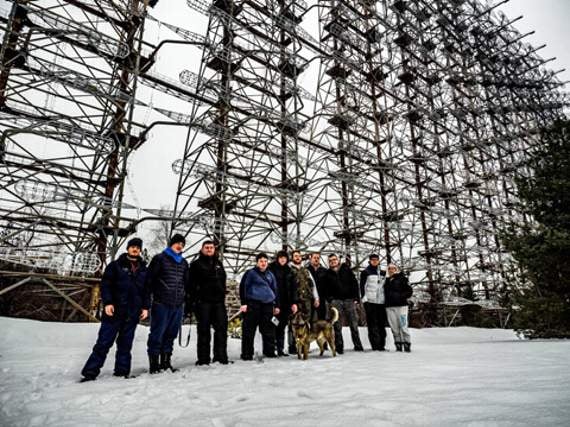
WHILE many British people fly off on holiday to warmer climes during the winter Dan Dollin, an adventurous Bude businessman, and nine of his friends recently made a 4,500-mile round trip by car across Europe to a bitterly cold Chernobyl in Ukraine, the site of one of the greatest nuclear catastrophes ever to cast a shadow across our world, writes Christine Williams.
On April 26, 1986 a power surge disrupted a systems test and Chernobyl Reactor No.4 went into meltdown.
The blast pierced the roof and a second explosion blew a cloud of radioactive material into the atmosphere 400 times more toxic than the combined fallout over Hiroshima and Nagasaki during the Second World War and it swept across the continent as far as the UK.
The ten friends stayed in a chalet 3.5 miles outside an exclusion zone which surrounds the area where contamination from nuclear fallout is highest and although public access is restricted they were given free rein to explore with a guide.


Inside the exclusion zone the damaged reactor is now encased in concrete and steel, and is covered by an arched shaped dome called the ‘Sarcophagus’.
In nearby, still radio-active, Chernobyl town live workers charged with decommissioning the active power plants.
Dan and his friends posed for a photograph in front of the Duga, a gigantic antenna system located in a forest.
This was a Soviet over-the-horizon radar system, used as part of a missile defence early-warning radar network.
They visited Pripyat, once a bustling city of 200,000 people, but now a ghost town with Soviet era apartment blocks frozen in time. There is an abandoned ferris wheel, which no doubt once brought pleasure to the inhabitants.
Personal items strewn here and there indicated the haste with which people evacuated their homes and some of the most poignant reminders of their panic were in the hospital with a reception desk still in place, heavy furniture lying across the floor, a ransacked operating theatre and drug cupboards.
The visitors befriended some of the hundreds of stray dogs roaming around Chernobyl. They are mainly descendants of those left behind after the disaster, when residents were forbidden to take their beloved pets to safety.
The most emotional experience of the whole trip was standing before a monument called ‘To Those Who Saved The World’.
It is dedicated to the people who gave their lives to protect the world from an even larger nuclear disaster; doctors, miners, firefighters and ‘liquidators’, 250,000 healthy young soldiers who were sent into the perilous situation in the first year.
Dan said: “You could read the expression on their faces, and almost wipe the sweat from their heavily furrowed brows. Every one of us living in Europe owes these people a debt of gratitude.
“At the end of the visits there were two radiation check-points where visitors had to climb through a machine and the barrier does not open unless you ‘pass’!”
Next year Dan plans to visit Kaliningrad, a Russian exclave between Poland and Lithuania on the Baltic Sea.
Comments
This article has no comments yet. Be the first to leave a comment.