
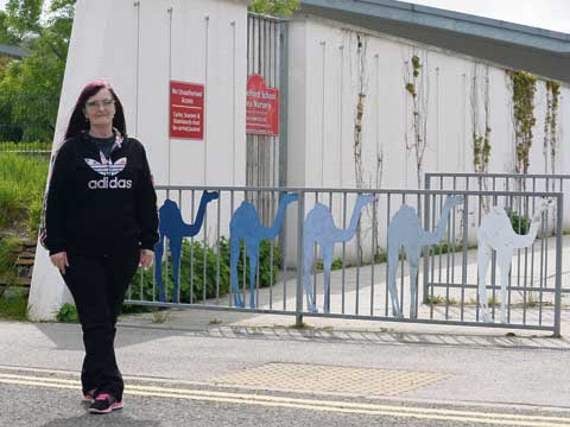
A WOMAN from Camelford has expressed her concerns about the safety of a road leading to the local primary school.
Helen Parkyn has become increasingly concerned about the welfare of local children due to the position of a road located along the Camelford Primary School site.
She is now campaigning for a zebra crossing to be installed directly opposite the entrance to the school to ensure better safety for local schoolchildren.
Helen started a campaigning group in 2011, when she began taking her granddaughter to nursery school.
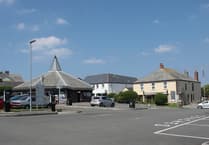
She noticed how most people were using the speed hump outside the school entrance as a crossing.
“It is a wide hump and covers the whole entrance to the school, and naturally looks like where to cross.
“If anybody is waiting to cross, 98% of cars and vehicles stop to let them cross. I started the group and added a few friends just to see what other people felt and thought — they all agreed it was a sensible idea and started adding their friends too.”
After contacting Cornwall Council, she was told that a zebra crossing would not be possible as it was too close to the ‘almost-90 degree’ bend for people to slow down in time.
The bend is narrow, so Helen thinks speed is not an issue as she claims motorists already slow for the sharp and narrow bend.
She said: “I argued that if the crossing was going to be too close to the bend, then the hump should never have been put there in the first place as people wouldn’t have time to slow down for it. Cormac put up 20mph signs, but they don’t make any difference really, as vehicles have already slowed down to negotiate the bend or hump. I also argued the zebra crossing down town by the Co-op is right on a junction, which is more dangerous and hazardous.”
In March 2017, Cormac confirmed it was ‘far enough away from the corner to meet qualifying criteria’, then proposed to do a footfall count to see if a zebra crossing could be warranted for the road.
Helen said the day that was picked to carry out the footfall count was a day that saw an after school cake sale take place, meaning not many people came out at the normal after school time.
Helen spoke to the Cormac representative and explained what was going on at the school, but was told he would not be able to stay past the time he had been scheduled for.
She then requested through a local councillor that Cormac carry out another count, but from the times of 7.45am to 9.15am and 2.30pm to 3.20pm to cover both Sir James Smith’s School’s and Camelford Primary School’s times.
Now the primary school has been granted permission for three more classrooms to be built, freeing up space for an extra 90 children, which Helen thinks needs to be ‘seriously looked at’.
Helen believes a zebra crossing would benefit Camelford Primary School, Sir James Smith’s School, the local mother and baby group and the health centre for baby weigh-ins, which are held in the primary school.
She said: “A mum stopped me one day and told me that she had stopped for children to cross the road one day and a car had pulled out around her and overtaken her, narrowly missing children crossing the road.
“People have offered to paint white lines on the hump in the night, but I have said we have to do this the correct way, or it will never happen. Either paint white lines on the hump so it’s clear it’s a place to cross, or do away with the hump as it’s giving out a false message. Make things clear, one way or the other.”
A Cornwall Council spokesman said: “This site was previously evaluated for a controlled crossing and did not meet the nationally-recognised criteria. This was why a school crossing patrol has been situated at the location previously, but not a controlled crossing.
“Due to concerns about safety it has been agreed with Rob Rotchell [Lib Dm Cornwall Councillor for Camelford ward] that a Highways Officer will revisit this site taking into consideration the planning permission and the potential increase in pupil numbers.
“We wouldn’t expect these additional 90 pupil spaces to make a difference as not all of these pupils will walk to school and national guidance on formal crossings has to be considered to ensure that they are only provided where they are justified and would improve safety. However once we have received confirmation of the exact numbers we will be in a position to advise accordingly.”
Comments
This article has no comments yet. Be the first to leave a comment.