
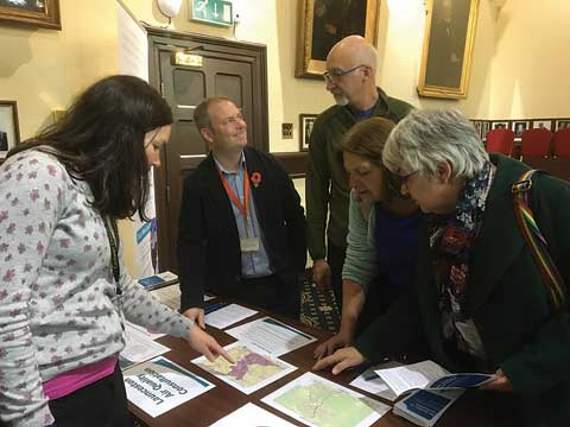
A BYPASS is not an ‘impossible’ option for Launceston, council officers said last week when consulting local people on what they think should be done to improve air quality in the area.
However, Cornwall Council believes a bypass, that would likely cost around £40-million, is ‘unlikely to significantly improve congestion/air quality due to local traffic volume’.
Cornwall Council officers were on-hand at a drop-in session in Launceston Town Hall on Wednesday, November 8 as part of public consultation ahead of declaring the town an ‘Air Quality Management Area’.
The council has been monitoring nitrogen dioxide levels in Launceston since January 2016.


Visitors to the drop-in session heard the biggest source of nitrogen dioxide (NO2) is the exhaust gases from cars and lorries, particularly in the Newport Square and St Thomas Road area on the A388.
While residents expressed that they felt a bypass would divert heavy goods vehicles from the Newport area, council officers said the worst impact — 44% — is actually from private diesel cars, compared to a 14% impact from HGVs. Seventy per cent of north-south vehicle trips are local, according to the council.
Council environmental protection officer, Eloise Travis, said: “I don’t think [a bypass] is impossible, however, transport colleagues have undertaken a survey of traffic flows around the town and we know 70% is local so a bypass isn’t going to take that 70% off the road. It’s the private journeys which are the real key thing for us.
“We are here to consult with residents and businesses in Launceston about the problem with air quality, the need for an Air Quality Management Area and their views on what could be done to improve air quality. We are really interested in what local people think because they live here and experience the traffic problems.
“So far I think everybody has been in favour of declaring an Air Quality Management Area and recognise there is a problem with traffic and congestion.”
Launceston could be declared an Air Quality Management Area before Christmas or in the new year, but the decision requires the official sign-off of portfolio holder for environment and public protection, Sue James.
Ms Travis said after this period of consultation and after the area is declared, there will be another consultation on ideas as part of an ‘action plan’.
Ideas from the public put forward in this period of consultation would be taken into account.
Some residents raised concerns that the Kensey Valley area and Launceston Retail Park were not included in the proposed Air Quality Management Area boundary as shown at the drop-in session. Some mentioned their concerns the omission of the Kensey Valley area could at some point pave the way for the construction of a controversial road linking the Kensey Valley to Newport Industrial Estate.
Cornwall Council had said the proposed boundary ‘encompasses the whole town’, and Ms Travis said after this consultation period it may be that the Kensey Valley and Launceston Retail Park are included in the boundary — she said their omission ‘may just be an oversight’.
“The proposed boundary looks quite large. Anybody that lives or works or drives around the area can contribute to the air quality problem,” she said.
Resident Gill Brown was one of those who went along to the session to find out more. She said: “At this stage it really is just a consultation about what’s included in the area and I’m quite surprised to see Kensey Valley Meadow is practically the only bit of the town not included in it.”
Another Launceston resident, Jan Broom, said she felt roads such as the A388 should be ‘downgraded’ and closed to HGVs, adding: “There should be depots on the outskirts of town for HGVs, so local businesses, if having goods delivered from up country, there are depots where goods are transferred to preferably electric vehicles. It’s what they are doing more and more in bigger cities.”
Cornwall Council officer Jennifer Graham said of the consultation ahead of declaring Launceston an Air Quality Management Area: “We’re not just saying it’s a problem belonging to these roads (St Thomas Road, Newport Square), it’s all the road users that contribute to it.
“The bottom line is we have a duty to monitor air quality in the county so where we think there might be an issue we are obliged to monitor, which we have been doing with diffusion tubes. There are higher than acceptable levels [of air pollution].
“If there’s no pavement, houses have no buffer. If you get houses really close to the road there’s nowhere for it to disperse. Just a few metres can make all the difference.
“Although lorries have an impact and ideally we would have less lorries coming through a place like this if only to improve the environment, diesel cars play a bigger part in the measure of pollution in this area.”
The concentration of NO2 is measured in micrograms (µg) in each cubic metre of air.
Council officers said the annual mean concentration limit (µg/m3) is 40, and the 2017 data, which is subject to change, showed that the levels were 44.63 at 9 Newport Square; 41.36 at Tannery House, St Thomas Road; 40.46 at 39 St Thomas Road; 44.67 at 46 St Thomas Road; 78.68 at 42 St Thomas Road and 47.07 at Duocott Cnr, St Thomas Road/Wooda Road.
The consultation runs until December 8, and people can share their views with the council online via www.cornwall.gov.uk/environment-and-planning/environmental-protection/environmental-protection-air-quality/launceston-air-quality/, where there is an online survey that can be printed; by emailing [email protected], calling 0300 1234 212, writing to Environmental Protection, Cornwall Council One Stop Shop, Dolcoath Avenue, Camborne, TR14 8SX, or by handing in your comments to any One Stop Shop.
Comments
This article has no comments yet. Be the first to leave a comment.