
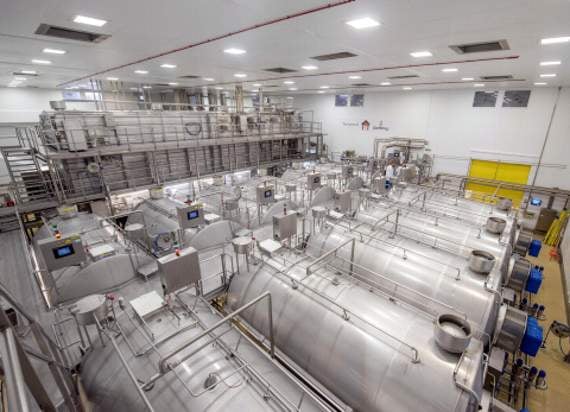
Dairy Crest has submitted a planning application for a £75-million expansion of Davidstow creamery.
The investment aims to boost cheddar production capacity at the plant by 40% from 54,000 tonnes a year to 77,000 tonnes to support the further growth at home and overseas of Dairy Crest’s leading cheddar brand, Cathedral City, which is made exclusively at Davidstow.
The creamery currently contributes to around £200-million a year to the local economy. Dairy Crest spends around £150-million a year buying 500-million litres of milk sourced from 330 dairy farmers across the South West, and an additional £50-million in the local economy on wages, transport and other costs.
The expansion would require a further 200-million litres of milk, worth an extra £60-million a year to West Country farmers, for the Davidstow plant which is already the biggest creamery in the UK.



The creamery’s expansion project is mostly focused on installing, replacing and improving equipment within the existing confines of the site, with almost no new building work at the creamery.
Dairy Crest has submitted a hybrid planning application for detailed permission to upgrade the creamery, and an outline permission to upgrade its existing waste water treatment plant.
Upgrading the waste water treatment plant is aimed at recycling more of the approximately 3,000 tonnes of water the creamery uses each day, to fully remove reliance on South West Water. Currently around half is recycled.
Davidstow site director, Dylan Ellis, said: “This project represents a major investment by Dairy Crest that will boost capacity, help with the long term security of the 200 jobs on site, reduce our environmental impact and create new opportunities for milk suppliers across the region.
“We are already talking to our existing farmers in Cornwall and Devon about increasing their production and we are also looking to expand our milk pool into Somerset. We hope that will give farmers the confidence to invest, knowing that there is a market for their milk.”
It is believed that the new treatment plant will also address issues of odour, to reduce any impact on neighbours.
Local residents will be pleased, as it was one of the concerns raised at a public consultation meeting, back in October 2018.
At the consultation, a Davidstow Residents’ Action Group spokesperson claimed: “We’re proud of the creamery in the role of the jobs they provide, but for local residents there are several issues. Number one is the bad odour emissions. Secondly there’s a lot of noise, and with further expansion it’s only going to get worse.”
Dairy Crest said the design of the treatment plant will be determined once it has agreed a revised environmental permit with the Environment Agency to take account of future increased cheese production, and stressed that the plant would be designed to be fully compliant with agreed limits.
The plans have also been welcomed by the chairman of Dairy Crest Direct, Steve Bone. Dairy Crest Direct is the organisation that works with Dairy Crest to negotiate price and their contract on behalf of farmers.
At the public consultation meeting in October 2018, Mr Bone said: “In a time where we’re facing a lot of uncertainty in the agricultural industry, such as Brexit etc, we’re pleased there’s a company out there willing to invest in milk processing in an area where there is a lot of milk produced. We see it as a positive, giving our members the opportunity to supply Dairy Crest with more milk if they so wish. If the guys want to expand, the high welfare standards that we as Dairy Crest producers work to, dictate that there’s a high degree of labour necessary to look after the dairy cattle.
“Throughout that whole supply chain, there’s more of the same. Although Brexit looks like it could cause challenges on the farm, this is an expansion which could create opportunities for businesses. It’s much needed. We’ve been through a very challenging summer in terms of drought conditions having a huge effect on feedstock, farmers are looking for positives in some fairly difficult times.”
A parallel planning application will shortly be submitted by solar energy developer Lightsource BP for a solar park next to the creamery that will generate 10% of its current annual demand for electricity. This will reduce the site’s carbon footprint by around 1,200 tonnes of CO2 per year, equivalent to the emissions of almost 500 typical UK households.
Cornwall Council will formally consult on the applications before making a decision later this year.
Jon Hurrell, CEO of the Cornwall Manufacturers Group, welcomed the news, saying: “This announcement confirms Dairy Crest’s market-leading position and is not just an investment in future-proofing their global production at the UK’s biggest creamery but also shines the spotlight on Cornwall’s manufacturing industry.
“At the last count, manufacturing in Cornwall contributed over £800-million gross value added and employed over 16,000 people. With fresh investments such as this and with ongoing financing across capital and infrastructure projects by a number of our members, the county’s manufacturing industry is enforcing its position as a major economic contributor to Cornwall, alongside the more identifiable agriculture and tourism industries.”
Comments
This article has no comments yet. Be the first to leave a comment.