
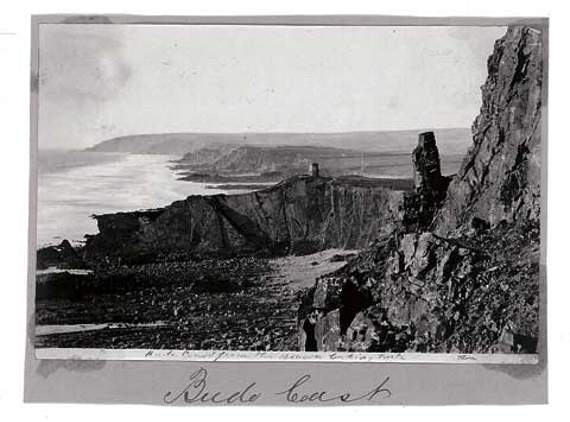
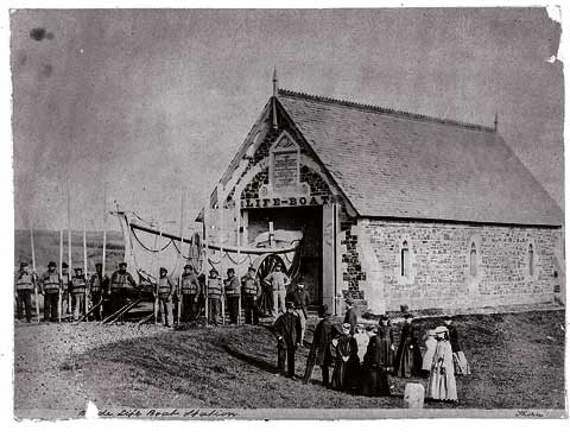


A BOOK telling the pictorial history of Bude and its people through a series of old and vintage images is due to give local people an insight into their heritage.
Cousins, David and Stuart Thorn, authors of Thorns of Bude, knew of their photographer relatives from a young age and realised their contribution to local and Cornish history had not been given the recognition it deserved.
The Thorn photographers consisted of, firstly, Harry, followed by his siblings Samuel and Sarah, and later by his niece Nellie and her husband, Jake Harrison, who continued the business after Harry’s death in the 1920s.
The Thorns’ photographs are to be seen all over Bude, and have become very familiar to everyone who perhaps took them for granted.




David Thorn, co-author, acquired a few Thorn glass negatives 30 years ago, but it was just three years ago when he decided their story should be told. He and his cousin, Stuart, then embarked on the long task of gathering together information about their relatives.
Harry Thorn, born in 1838 in Stratton, was the first photographer in Bude, during a time in the development of photography that made taking a picture a long process. He began his work in the late 1850s, having to use a dark room or tent to make and process negatives on site during the early stages of photography.
It took approximately half an hour to make and develop a negative. Harry was joined later on in his enterprise by his brother and sister, Samuel and Sarah Thorn, as well as Sarah’s daughter Nellie and her husband Jake.
David and Stuart used family archives, notes and observations, passed down by their fathers and other relatives, together with a collection of glass negatives. The cousins were also fortunate to have a number of Thorn glass negatives given to them by a local friend, who recognised their importance and saved them from disappearing from Bude.
Other Bude historians and collectors also contributed with photographs and information.
Research involved putting a date and story to each photograph, and the census records from 1841 proved a valuable source for checking Bude as it developed. It was possible to date some photographs from these records, and in some cases change the known history.
David and Stuart believe that the Thorn photographers of Bude are equally as important for their contribution to their local history as the Gibsons of Scilly were in their area, being well known for their collection of negatives that have recently been acquired by the National Maritime Museum at Greenwich.
The Post was given the opportunity to take a glimpse into the world of the Thorn photographers, whom are given a detailed and fitting commemoration in Thorns of Bude.
The book illustrates perfectly the ever changing world of photography, and follows the journey of evolution of Harry Thorn and his skilled work as a photographer, passing the trade on to his close family, as well as the development of Bude, shown through a century of photographic evidence.
Thorns of Bude includes the Thorn family tree and their background, as well as the history of photography and the way Harry Thorn and his beloved Bude played such a large part in the development of the skill. The reader is allowed to take a glimpse into Harry Thorn’s world, creating a sense of being there alongside him as he captures local historic moments for future generations to enjoy.
Among just some of the vast array of topics included in Thorns of Bude, images portray life in rural areas around Bude, as well as in the town itself, giving an idea of what life would have been like for a local reader’s great grandparents during their time.
The photographs — ranging from the mid 1800s to the early 20th century — also include the topic of churches and religion in Bude; shipwrecks at local beaches, including the famous wreckages of the Bencoolen and the Elizabeth Scown, amongst others.
Bude’s beaches, particularly Summerleaze, are also a poignant part of the book. Readers are able to see how Victorian Bude residents would have spent their time at their local beaches, often witnessing ship wreckages, as well as how they would have celebrated the annual Bude Lifeboat Day, which is a highlight of the book.
Locals are seen lined up on the canal, crowding on the sand or gathering at the cliffs, eagerly awaiting the arrivals of the lifeboats and keen to celebrate the famous day for Bude.
Additionally, there are images of Bude Lifeboat Station, as well as shops on Belle Vue and the Strand, and the opening of the ‘new bathing pool’ in 1931, now known to many readers as Bude Sea Pool.
It is evident that Bude’s heritage is still a thriving part of life, and Thorns of Bude really depicts the history of the town, its people and life in Bude between the mid 1800s to early 1930s.
There will be an exhibition of the photographs included in the book at the Castle, Bude from December 6 until December 31. David and Stuart will be there on Sunday, December 11.
Thorns of Bude will be available from Spencer Thorn Jewellers and Spencer Thorn Bookshop, priced at £24.99. The book can also be accessed from Halsgrove Direct on 01823 653777 or www.halsgrove.com.
For more information, visit www.thorns-of-bude-photographers.uk.
Comments
This article has no comments yet. Be the first to leave a comment.