
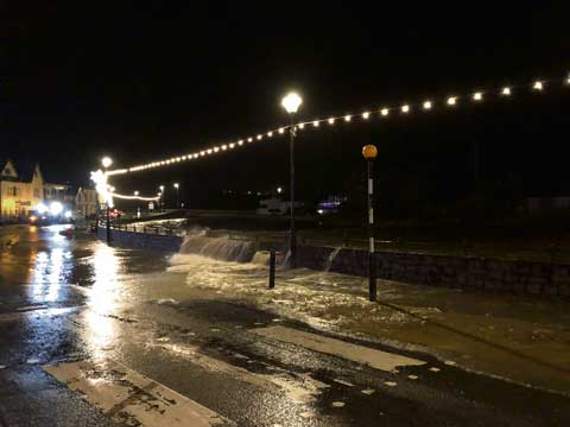
BUDE took a hit from the almighty Storm Eleanor last week.
Pictures from local man James Brooks illustrated the sheer volume of destruction that the storm could have potentially caused, with the wall along the Strand overflowing with water from the canal.
Various parts of Cornwall and Devon were affected by the storm, with reports of floods in Perranporth, destruction in Newquay and, more locally, a trampoline was removed from a tree in Launceston.
The Met Office issued weather and flood warnings, with strong winds and heavy rain hitting the region. Cornwall Fire and Rescue Service warned residents and visitors to be prepared and take precautions where necessary.



Strong winds and high tides are not a good combination — with the Met Office weather warning, residents were advised to stay away from exposed coastal locations, particularly during high tide.
Cornwall Council and CORMAC staff have since been working to deal with the aftermath of Storm Eleanor, including removing more than 40 fallen trees and dealing with localised surface water flooding throughout Cornwall.
Most work has been carried out in Portreath, following the collapse of a harbour wall to the western side of the village’s main car park.
In Bude, storms also contributed to the creation of a sand cliff on Summerleaze beach. At the meeting of Bude-Stratton Town Council last Thursday evening, January 4, councillors heard that massive erosions on the beach have meant that ‘serious structure work is to be done to save the RNLI station’, which is located on Summerleaze beach — a vital service to the community.
James Brooks, who took some astounding photographs of the storm lapping over the walls of the Strand one evening, said: “I think overall it was less serious than maybe the Environment Agency were expecting. That morning I had seen between ten to 15 Environment Agency staff in the area inspecting and keeping an eye on things, and had plant ready such as pumps, in case they were needed — I was very impressed by their response, actually.
“Businesses along the Strand seemed prepared with sandbags in doorways, as is normal when flooding is expected here, but thankfully the water did not reach the point of entering any property. Seems the wall was only being over topped when the large tidal bores came down the river, which was how the water built up, and generally the flood defences help up well to the water level.”
Also struck by the storm was Bude Canal, which has suffered some destruction to the bank at the back of the Castle as a result of the storm and high tides. The line of the sand railway was also eroded with rock brought in by the waves.
Peter Moores, mayor of Bude and Stratton, said: “There was, fortunately, no damage to business premises or to domestic dwellings as a result of the recent high tides.
“On the face of it Summerleaze beach looks as if it has suffered a loss of a significant amount of sand. In reality the level of the beach is much the same as it was when I was a young child – over 50 years ago. The boulders which have been exposed (once again) were put in place during the 1980s to protect a row of beach huts, which themselves were based upon a man-made ridge.
“The area behind this ridge used to be well below the level of the car park, as did the whole of the area which is now covered by the ‘dunes’. Once it had been decided not to place beach huts on the man-made ridge the conditions became right to facilitate blown sand to build up to the level it is today. This gives the impression that serious erosion has recently taken place, which in reality is not the case.
“I hope that publicity on national TV will not give the wrong impression that Summerleaze beach has been wrecked because it hasn’t. After a few hours work with a swing shovel the sand between the exposed boulders and the Lifeboat Station could be re-profiled and rectify the situation.”
Comments
This article has no comments yet. Be the first to leave a comment.