
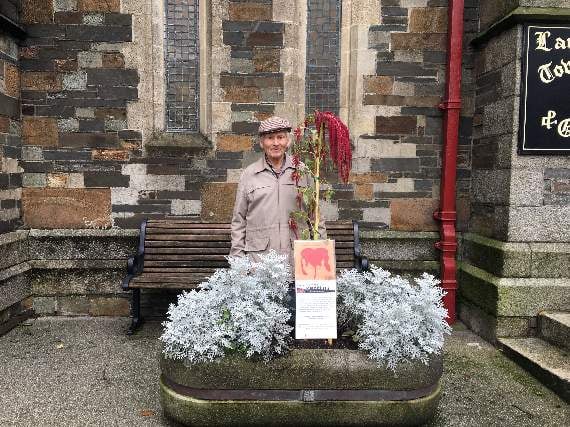
JIM Edwards from Launceston has donated a beautiful plant with crimson flowers to Launceston Town Hall, in order to remember the fallen from the town and mark the centenary of the signing of the Armistice.
Jim — or ‘the Oracle’, as he is known to many due to his extensive historic knowledge on the town — in conjunction with the overall efforts made in Launceston to mark the special centenary of the end of the First World War this November, has donated a ‘Bleeding Heart’ plant to be displayed at the front of Launceston Town Hall as an act of remembrance.
The plant, with its crimson red flower blooming from the long stems, is a poignant and fitting tribute to remind those of us living in Launceston today that 100 years ago, local men were fighting in a conflict once thought to ‘end all wars’ and, sadly, many lost their lives.
Jim grew the plant himself, and has been growing it since April. He said: “The recent frost was starting to take it in my garden, so I thought it would be nice to put it somewhere in town for the remembrance events. I was going to put it up by the memorial (in the town square), but it would be in the wind too much.”



After gaining permission from Launceston Town Council, Jim placed the plant in a planter outside the front of Launceston Town Hall on Wednesday, November 7. “It suits the theme of this week,” Jim continued. “And it supports Roger Pyke’s exhibition in the town over the weekend. When the frost comes, it will die anyway, so I will probably just cut it back once the remembrance events are over.
“It’s just to show that some people care.”
Fellow Launceston historian Roger Pyke, who set up the Launceston Then website with Jim’s help, organised a free exhibition at Launceston Central Methodist Church over the remembrance weekend, from November 9 to 11, to commemorate the centenary and provide stories of the lives of the fallen from Launceston and immediate parishes. The story of the home front was also explored, including how the town and district helped Belgian refugees and how the Women’s Land Army can trace its beginnings to the Launceston Women’s Suffrage Society.
Comments
This article has no comments yet. Be the first to leave a comment.