
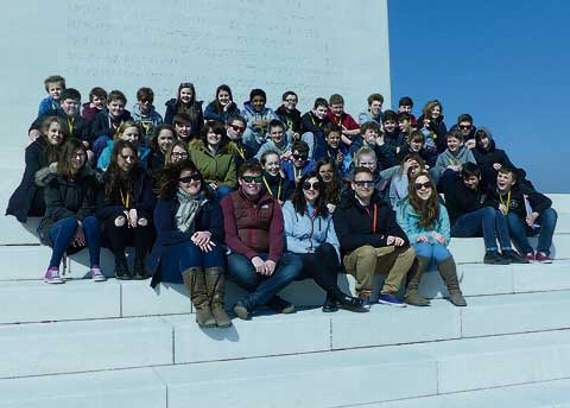
IN THE early hours of the morning on March 14, 39 weary eyed, yet enthusiastic, Launceston College students, accompanied by five intrepid teachers, set off on their journey to Ypres, Belgium.
Ahead, they faced the most engaging trip to Belgium and France — the trip involved visits to many cemeteries, memorials and trenches.
Throughout the week, they visited many historical sites including; the Indian Memorial, Ulster Tower, Thiepval Wood and Memorial, Lijssenthoek Military Cemetery, Passchendale Memorial Museum, Tyne Cot, Langemarck German Cemetery, Essex Farm, Menin Gate and Vimy Ridge.
One of the first sites they visited was The Indian Memorial at Neuve Chapelle. This is a place where the Indians, who are often forgotten for their contributions during the war, can be remembered.

Students described the memorial to be ‘peaceful’, ‘very interesting’ and ‘incredible’.
Many of the students seemed surprised to see how different the memorial, specifically the unique architecture, was compared to other memorials that they had seen on past occasions.
The memorial is dedicated to Indian society which is expertly showed through twelve symbols of Indian culture sculpted onto the walls. A sculpture on the grounds of the memorial also shows two tigers, native to India, and a star on top of a column which is representative of India.
On the third day, they ventured to the Passchendale Memorial Museum. This museum commemorates the Battle of the Ypres Salient.
Students were asked to choose an artefact to draw and write about. There was a vast array of chosen artefacts that ranged from trenchscopes to gas masks.
It was very interesting to see how they had reconstructed trenches to be part of the museum. The teachers gave students a range of different challenges throughout the duration and one challenge was to find the name of a WW1 bunker in the trench — after many minutes of searching, they found the name to be a ‘French Pattern Elephant’.
After the day at Passchendale, the students were asked to fill out a grid that explained how they felt about the day. Opinions ranged from empathising with the soldiers and their families to being shocked about the amount of graves that were witnessed.
The group were enamoured with a compelling visit to Vimy Ridge. It was at Vimy Ridge that Canadian troops battled the Germans and many died for the British Empire.
The Vimy Ridge memorial was designed by a Canadian to remember their efforts and actions, which later proved successful for their solo war efforts without any assistance from the Britons.
The Canadian and German trenches were reconstructed in concrete in order to preserve the memory of trench life during WW1.
Students and teachers witnessed breath-taking views at the memorial and it was described as ‘a must-see for anyone who is even remotely interested in world conflict’.
The Ollie Peterson-Belgium trip was a complete success with all of the students and the teachers.
The trip was ‘an experience I’ll never forget’ said Jennifer Hamlyn and ‘really powerful and meaningful’ said Emily Nolan.
All students strongly encourage others to take up the opportunity when they reach Year 9.