
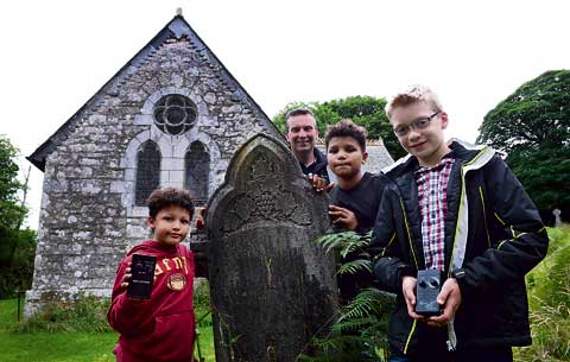
THERE was a bat survey/count recently at Temple Church in preparation for a licence to undertake the re-roofing works.
Last month, Temple Church received the amazing news that they had been granted £70,300 through the government-funded Listed Places of Worship, Roof Repair Fund.
The grant, successfully applied for by Blisland Parochial Church Council, and supported by a Temple residents working group, is a wonderful contribution to the target figure of £90,000, to enable the building to be re–roofed and repairs undertaken to the tower and surface drainage.
Bats are fascinating long lived mammals and in this country they are all insectivorous.




A single pipistrelle bat can consume up to 3,000 midge-size insects a night and they live in well-established social colonies.
Bats tend to have different requirements between the summer when they breed and the winter when they are less active.
Bats tend to use buildings with a warm south facing aspect for maternity roosts and some species are equally at home in a modern bungalow as a barn.
In older buildings such as churches they may have been in occupation for hundreds of years and at Temple church the colonies are well established.
They include Brown Long Eared as well as Natters bats and Pipistrelles.
Different bats use different aspects of the building with some behind slates whilst others a crevice in the walls.
Bats are protected by law under a range of legislation. These include the Wildlife & Countryside Act (1981), the Natural Environment and Rural Communities Act (2006), and the Conservation of Habitat and Species Regulations (2010).
This reflects the significant declines that have taken place in the population size over the last century. The legislation not only protects the bat but also the space within which it lives.
In order to make changes to a building that contains bats you are required to apply to Natural England for a licence, which normally involves survey works.
At Temple, the re-roofing of the church, St Catherine’s, could disturb the bats, so surveys are now being undertaken to identify the species present, how they use the building and how best to accommodate their needs prior to submitting a licence application.
Currently there are over 200 bats in the church counted in July and it is expected this number will rise in August once all the youngsters are also on the wing.
The lead consultants are Spalding Associates and Simon Barnard is coordinating the work on the PCC’s behalf.
Bat facts include:
l All UK bat species use echolocation to navigate and hunt for insects in the dark;
l A tiny Pipistrelle can eat up to 3,000 insects in a night;
l Things we get from bat-adapted plants include dates, vanilla, bananas, breadfruit, guavas, iroko timber, balsa wood, sisal, tequila and chewing gum!
l Bats are more closely related to humans than they are to mice.
l The majority of the world’s bats eat insects — just like British bats. In the tropics bats also eat foods like fruit, flowers, frogs, fish, blood, even other bats.
l Bats usually only have one baby a year and can live for up to 30 years.
Karen Dickin, chairman of the PCC’s Residents Sub Group for the re-roofing project at Temple Church, said: “The bats are very much part of St Catherine’s so it’s important we understand their needs as well as those of the congregation in planning the roof refurbishment.
“It’s been a fascinating evening joining in with the recent bat survey and a real eye opener into the sounds and world of bats.”
Comments
This article has no comments yet. Be the first to leave a comment.