
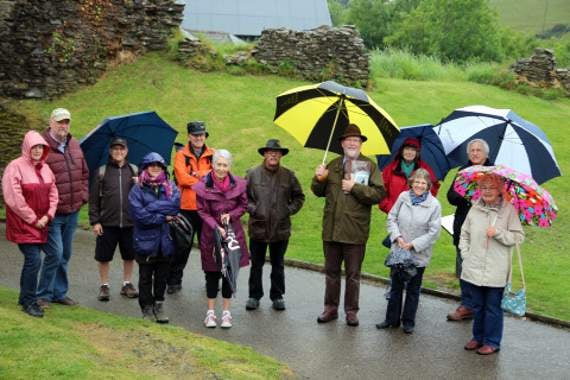
‘ALWAYS look up’, is what a group were told by Launceston town crier, Rob Tremain, as he led them on a trek around the town as part of the Charles Causley Festival.
Starting at the castle green, there was a surprising number of people that had turned up to join Cllr Tremain, despite the less than delightful weather.
With the ringing of the quarter jacks from the town hall, Cllr Tremain began his insightful tour around the town, which is rich in history, from kings and dukes to the grotty gallows of Doomsdale prison and the tragic tale that led to the St Mary Magdalene Church known to locals today.
“In Lanson, they say you can tell the summer is in Cornwall because the rain’s warmer, so we’ll have to test that out today I think,” Cllr Tremain told the group as the rain began to drench umbrellas and coats.


The group briefly learnt about the gateway to the castle, revealing the history of kings and riches.
Cllr Tremain said: “This great barbican gateway into the castle, it looks a lot different today than it would have done when the castle was all bright and shiny and new.”
He explained that there wouldn’t have been a palace moat, with ‘swans gently swimming’: “It’s the mucky, nasty, muddy (water) where all the rubbish and everything was thrown. Outside the Westgate Inn was a town well and the water would flow along. It would stop thugs getting into the castle. If you didn’t want the boards strewn across and as you came into the castle, fine, but if they didn’t want you to come in, the boards would be taken down and you’d have to sort of come through all the mud and the muck and the water to get into the castle. So it would have looked a lot different back in the day.”
Staying on the tarmac path running through the castle grounds, the group made their way to the grisly jail — fittingly named ‘Doomsdale’.
“The origins of Lanson go way, way back,” the group heard. “Before the Norman conquest, the main settlement of the area was across the valley. It was at St Stephen’s, the present day St Stephen’s, known as Lanstephan — ‘Lan’ in the Cornish language, the holy site, and ‘Stephan’ — Steven, the holy site of Steven. The Saxon tongue for ‘township’ was on the end, so ‘Lanstephanton’. I suppose you can see where I’m coming from that eventually the Lanstephanton became the Launceston or the lazy Lanson as we say today.
“There was a Monastery, market, royal mint — (it was a) real busy place, a huge bustling community. Things changed a bit after 1066. There was a battle up in east Sussex and William (the conqueror) arrived with his Normans. Brian of Brittany, the first Norman overlord, was sent down here. He didn’t last very long, but he started to build on the wooden palacaid which would have been where today’s castle is. There would have been a hillfort of some sort here. And the community on this side of the valley was called Dunheved. After a while Robert, Earl of Mortain — William the Conqueror’s half brother — he was put in charge of everything down here in the South West. He ruled a huge part of the country — the greatest landowner in the country after the king, a very important guy.”
Focusing on Doomsdale, of which the ancient gate remains, the group were told that prisoners faced cramped, squalor conditions. “On the other side of the green really a horrible place to be, its name was Doomsdale — I think that says it all, really,” Cllr Tremain said. “There would have been imported prisoners here at the time, plus lots of other lesser mortals. It was the place to be incarcerated.
“There was a deep pit, three fathoms below ground, three fathoms, six foot, I think. There was another storey above here, which was the jailers and gatehouse keeper, where he lived. You can see there were two gates at one time. If you look up and get a drip in your eye, there was a portcullis that lowered through the slot. If they didn’t want you to get in or get out, you wouldn’t have.”
As you come away from the remains of Doomsdale, the magnificent Eagle House Hotel is immediately to your left, a beautiful Georgian townhouse, built in 1764 by Corydon Carpenter — whose story is a real ‘rags to riches’ tale.
Then it was on to Castle Street, where the town’s local businessmen resided. “In the early 1800s a number of French naval officers were captured during the Napoleonic wars. Dartmoor prison was built for their use, but the officers were allowed out to lodge with local families in parol towns. They weren’t allowed to move more than a mile from the centre of the town. I think there’s still a marker on Polson Bridge. Castle Street, which was home to a lot of the prominent businessmen of the town, was where some of these French officers lodged. Their headquarters was number 9, Lawrence House Museum — well worth a visit.”
As the group made their way from the ‘finest Georgian street in Cornwall’, their attention turned to the slate-hung houses edging towards Northgate Street. The Northgate Inn, now converted into flats, was the site of the north gate into Launceston. “If you were coming from Bude, Holsworthy, that direction, you would have come across the ford where the road bridge is now by Greenaways or over by St Thomas’ Church, drive sharp across the priors bridge, and start to climb up into the town.
“We can see the gable ends of St Thomas’ Church, down in the valley. To the left of St Thomas’ Church would have been the great priory — absolutely huge building — the richest priory, Monastery in Cornwall. Back at the time of Henry the fifth and Agincourt, they needed to raise money to pay the troops, and the king’s jewels were pawned by the prior of Lanson. We ain’t got the king’s jewels, so I assume the debt was repaid, which in those days the debt for the king didn’t usually get repaid.”
The party approached the steps, and headed up the steep path, past an old cottage — formerly the Ring O’Bells pub. There were once 40 pubs in Launceston. At the top of Northgate Street, nestled between the Central Methodist Church and St Mary Magdalene Church, the group paused to note the great architecture.
At the end of Northgate Street is Tower Street, fitting when the tower of St Mary Magdalene Church shadows the ancient buildings surrounding it, which then allowed Cllr Tremain to introduce the group to the iconic Bell Inn, the oldest pub in Launceston.
“The church tower, you see today, dates to 1380. Edward the Black Prince, the first Duke of Cornwall, it was he who had the new church built in 1380. There was a chapel of St Mary Magdalene just in the castle grounds. I often say to folks, look up. They don’t take enough notice of the castle, it absolutely dominates the town.”
With that, the group only had to take a short walk around the corner to look directly at the entrance to St Mary’s church. “There’s a gap between the fantastically carved granite church and the tower. There were a couple of cottages there until the 1800s when the present vestry room was built. The Duke of Northumberland lived at Werrington Park for some time of the year and he was a local MP and did a lot of work within the town. He landscaped the castle green from the pretty poor state it was in, and built the vestry room.
“But the main body of the church was built in 1511, completed about 1524 — the gift of Henry Trecarrell of Lezant, Trecarrell Manor in Lezant. The story goes he had daughters. Well, back in the day, daughters didn’t particularly count because they would marry and make good lives for themselves and their husbands would look after them. But then a son was born, which changed things.
“The baby son needed an inheritance and the old manor house was being rebuilt — the chapel was built, the great hall was started. The nurse left the babe in the basin of water where it was having its bath and when she came back with a clean towel, the babe had drowned. This was absolutely horrendous news for Henry, finished him off really. He sent the stone masons into Lanson to rebuild the church in memory of his baby son, and it’s absolutely fantastic. The carvings — there’s nothing like it.”
The Southgate Arch is a short walk from this part of the town, where there was once a prison, and there has been record of a bake house, the now closed Parker’s Bakery, since the 1700s.
In the town square, people can overlook Broad Street. “It’s a broad street, like its name,” Cllr Tremain said. “It was only 20ft wide.”
The White Hart Hotel, one of the town’s most iconic pubs, was rebuilt in 1767, the group heard. In 1722, the back of the pub was the site of the ‘new theatre’. T C Haliburton, a judge, retired to Cornwall and became the MP for the town in 1859. “When he stayed in Lanson, he liked the room above the White Hart sign.”
Despite once being the site of a pig market, the butter market in 1839 and then the war memorial, which was unveiled in 1921, as well as leading to what was once home to six pubs on Westgate Street, the town square has probably seen a few grisly sights too. When an unfortunate prisoner had received the death sentence, they were rushed along the square to ‘Hangman’s Alley’, which is now filled in by a door by the square’s Costa coffee shop, and then led to the jail at the castle.
As the walk came to a conclusion back at the entrance of St Mary’s church, Cllr Tremain finished by encouraging the group to always admire Launceston’s quaint streets and varied but incredible architecture. He said: “Keep looking up. It’s a hilltop town, but it’s ‘wow’!”
Comments
This article has no comments yet. Be the first to leave a comment.