
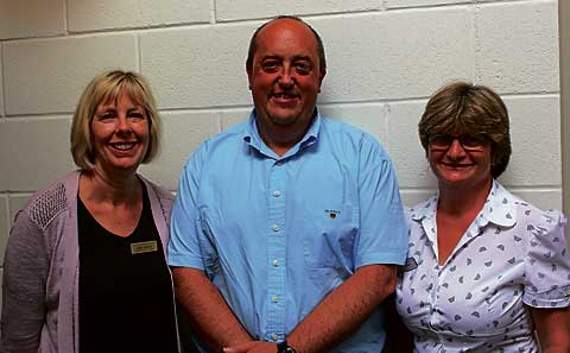
IN January this year Launceston Medical Centre became one of the first surgeries in the region to employ a paramedic.
Six months later the trial has proved a resounding success and now other surgeries are following Launceston’s lead and employing paramedics to cope with the increasing workloads faced by medical staff.
Medical centre business manager Peter Harper said: “We felt that the practice would benefit from having the skills of a paramedic who had the valuable experience of making home calls.
“In fact, it has worked so well that we would like to have a paramedic available more days each week now.

“We have been getting calls from other medical centres which are following our lead and recruiting paramedics.”
Marcus Wadland had been in the ambulance service locally for 27 years when he took the unusual step of working at the health centre for two days a week. He joined three experienced nurses as part of the minor illness team.
The minor illness team was effectively established at Launceston Medical Centre six years ago when both nurse practitioner Carol Jackson and minor illness nurse Peter Wyatt joined the practice. Four years ago, they were joined by minor illness nurse Christine Fielder who had previously worked at Launceston Hospital.
All four members of the minor illness team can help patients who are suffering from a range of illnesses ranging from throat infections and chesty coughs to urinary tract infections or skin infections.
In their roles they support the doctors by seeing patients with a range of minor illnesses and diagnosing, treating or referring them for more specialist attention. They relieve the pressure on the GPs, allowing them to deal with more complex cases, and that also allows the surgery to handle more patients each day.
The three nurses are all qualified nurse prescribers while the prescribing range of the paramedic is, at present, more limited and overseen by the doctors.
The nurses who, on average, each see 35 patients a day, deal with patients aged two years and upwards while Carol, who has run baby clinics in the past, sees patients of all ages.
Pete said: “Our work frees up the doctors to deal with acute cases and means there are more appointments available for patients who need to see a doctor.
“Triage — assessing a patient’s condition and deciding on the appropriate action — is a primary role for our team, so if we consider that a patient requires urgent attention or needs to see a doctor we will take the necessary steps.”
As the expertise and role of the minor illness team becomes better understood, many patients are now ringing to request appointments with a member of the team.
Carol said: “We have more time to spend with patients than the doctors. Whereas the doctors have ten minutes per patient, we can spend 15 minutes with them. So as well as helping with patients’ immediate problems, we are able to offer extra information and education.”
In addition to seeing patients at the surgery, Marcus’s paramedic experience means that he can help share the doctors’ load of home visits.
Marcus said: “Because the medical centre covers such a wide area, a lot of time can be taken just travelling to visit sick patients in the villages.
“That is valuable time that the doctors could be spending seeing patients at the surgery and, of course, dealing with sick people at their homes is something that I trained for and am used to.”
Comments
This article has no comments yet. Be the first to leave a comment.