
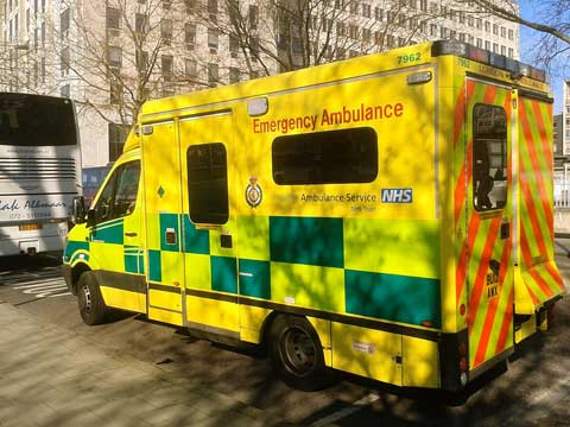
RESIDENTS in Camelford were given the chance to hear the ways in which the South Western Ambulance Service Foundation Trust is developing its service to meet the needs of patients across the region, writes Rosie Cripps.
Ian Penhaligon, operations manager of the East area, and Ashley Mann, operations manager, from the South Western Ambulance Service Foundation Trust (SWASFT), attended the most recent meeting of the Camelford Community Network Panel on Tuesday, December 12.
There, they updated the panel and local residents on the most recent and developing efforts being made to ensure the trust provides an appropriate and safe service for communities across Cornwall and beyond.
Ian introduced himself to the panel, stating that he is responsible for nine operations in Cornwall, and that 2017 is the 80th year of the implementation of the 999 service, which is made up of emergency assistants, assisting paramedics; paramedic emergency care assistants, who can give basic life support; and emergency care practitioners.




Staff working under the service are required to meet the government’s key performance indicators (KPI), which determine whether a journey to a patient has been successful or not. Ian gave an example — he said that if crews had arrived to a patient in seven minutes and 59 seconds, and the patient had died, the trip would be deemed a success because crews would have reached the patient in the limited time frame of eight minutes.
However, if crews had reached a patient in eight minutes and one second, and the patient survived, the trip could be considered a failure, as it would have gone over the eight-minute time frame.
Emergency responders will act accordingly when receiving a 999 call. When the person on the other end of the line speaks to an operator, they will be asked if the patient is breathing, if they are awake and if they can be awoken. From these three main points, it can be determined if a patient is suffering a cardiac arrest or respiratory arrest, which is a category one call. Ian said that these incidents receive a cut time frame to be at a patient’s service from eight minutes to seven minutes.
Phone operators are obligated to answer 95% of emergency calls in under five seconds, and an ambulance must be dispatched in 30 seconds to an unconscious cardiac or respiratory arrest patient.
Ian told the meeting: “We haven’t made things easier for ourselves. We’ve in fact made it harder in adopting the ARP (Ambulance Response Programme), because we’re trying to deliver an appropriate and rapid response to emergency calls.”
The meeting heard that stroke patients are category two calls, and complicated diabetics or patients with limb fractures or burns are category three calls. Category four calls are normally from healthcare professionals, such as midwives trying to undertake a complex delivery or GPs recommending that a patient should be transferred into a particular ward. These are considered the least urgent calls the service has to deal with.
The trust has also seen changes in rota plans and adopted the Ambulance Response Programme in autumn of 2017. Ian said: “This has been a really radical change, but is ensuring that the patient gets the correct care.”
The panel was introduced to operations manager, Ashley Mann, who explained that the service has had to ‘change the way in which we deliver a service to meet the needs of residents in the area’. He explained that by using their resources and financial envelope, they have to try and deliver the best service as possible.
Ashley asked the meeting if they have any examples of care in Camelford. Town councillor, Andy Shaw, said that the town used to have 24-hour cover with two ambulances and a paramedic car, starting at 7am in the morning and working until 5pm in the evening.
Ashley said: “To be able to deliver better care for Camelford, we’ve unfortunately lost the car, but we are now providing 24-hour cover and have provided a vehicle capable of transporting a patient to a definitive hospital, whether that’s Treliske, Barnstaple or Derriford — so we have increased our capability.”
This service covers an area dropping below Crackington Haven, right around to Port Isaac.
The meeting heard some statistics from the course of 2017 in the area. In January, there were 129 emergency calls, in June, 108, and August, 152. Ashley said: “That’s how many people dialled 999, but did they need an ambulance? Did they think about the other services available — 111, pharmacies and the minor injuries units?”
A total of 1,351 patients dialled 999 during a ten-month period, and only 600 patients were transported during that time. Ashley said: “What we want to do as a service is improve the service for everyone, whether it’s a category one call, a category two call and so on.”
Ian and Ashley also mentioned that ‘collaborative working’ is the way forward for the service, so the ambulance service has been working with police and fire services. The service also hopes to progress through OPE funding (One Public Estate), however, in specific areas in the region, rurality can make it very difficult for crews to ‘deliver a safe and effective service’, so this is something else they are currently looking into.
Ian added: “We’re not quite there yet, but with financial enhancement we are aiming to achieve and deliver the best.”
Comments
This article has no comments yet. Be the first to leave a comment.